Author name: amdg

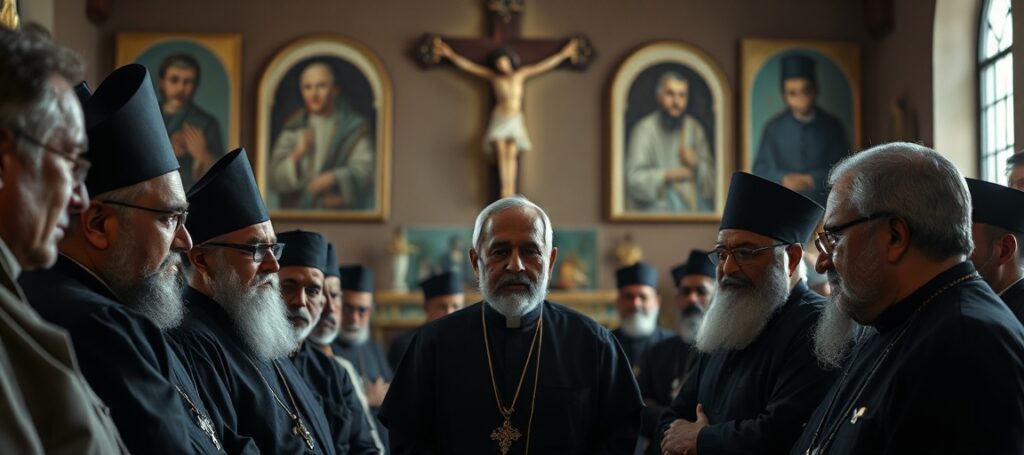
A Catholic priest in a cassock looks concerned at a Vatican document about digital evangelization.
Antichurch

Vatican’s Digital Mission: Modernist Naturalism Masquerading as Evangelization

The Vatican’s Synod on Synodality study group on “mission in the digital environment” has issued a final report proposing the creation of a “Pontifical Commission for Digital Culture and New Technologies” to oversee theological, pastoral, and canonical challenges online. The report warns of polarization, manipulation, and doctrinal drift on digital platforms, urging bishops’ conferences to recognize these ethical risks. It calls for integrating digital mission into ordinary Church structures, rethinking territorial jurisdiction for “supraterritorial” online communities, and developing tailored formation for “digital missionaries.” The proposals are framed as open-ended orientations for further discernment, reflecting the synodal “lens” of the post-conciliar “Church of the New Advent.” This article, published by EWTN News on March 3, 2026, reveals the conciliar sect’s complete surrender to naturalistic humanism and its abandonment of the supernatural mission of the Catholic Church.

Antichurch

Drexel’s “Saintliness”: Modernist Humanism in Eucharistic Disguise

The cited EWTN News article, first published in 2021 and updated in 2026, presents a hagiography of Katharine Drexel (1858–1955), emphasizing her wealth, founding of the Sisters of the Blessed Sacrament, establishment of schools for Black and Native Americans, and her 2000 canonization by “Pope” John Paul II. It frames her life’s work as a radical commitment to justice and Eucharistic devotion. The article’s thesis is that Drexel’s life exemplifies authentic Catholic social action. This portrayal, however, represents a profound theological and spiritual bankruptcy, masking a modernist agenda under traditional language.

Antichurch

Venezuelan Opposition Figure’s Faith: Naturalism Masquerading as Catholicism

The Pillar portal reports on an interview with Juan Pablo Guanipa, a prominent Venezuelan opposition politician and recent political prisoner, focusing on his self-described Catholic faith during incarceration. Guanipa details his personal prayer routines, gratitude to God for all circumstances—including imprisonment—and his hopes for Venezuela’s democratic liberation. He expresses admiration for St. John Paul II and references the Opus Dei-influenced spirituality of his father. Regarding the role of the Church, he calls for it to “impulse the liberation of Venezuela” and work for “stabilization of democracy,” while urging “Santo Padre” (Pope Francis) to empathize with Venezuelan suffering and support a political transition. He defends his political alliances with those holding positions contrary to Catholic teaching (e.g., on abortion) by asserting a personal, non-negotiable pro-life stance while refusing to isolate himself from dissenters.

This narrative, while emotionally resonant, represents a profound theological and spiritual bankruptcy. It is a quintessential product of the post-conciliar “religion of the heart,” utterly devoid of the supernatural, hierarchical, and dogmatic substance that defines the una sancta Catholic Church. Guanipa’s faith is a private, psychological comfort system perfectly tailored to the naturalistic humanism condemned by Pope Pius IX’s Syllabus of Errors and St. Pius X’s Lamentabili sane exitu. It is a faith that can coexist with heresy, apostasy, and the public worship of false gods, because it has been reduced to a set of personal pious exercises and political aspirations, stripped of its exclusive claim to truth and its duty to reign over all aspects of society.

Antichurch

Modernist Funeral Celebrates Apostate Cardinal Pengo

The Vatican News portal reports on the funeral of “Cardinal” Polycarp Pengo, “Archbishop” of Dar es Salaam, who died on 15 February 2026 and was buried on 28 February at the Pugu Pilgrimage Centre in Tanzania. The funeral Mass was “presided over” by “Archbishop” Jude Thaddaeus Ruwa’ichi, with burial rites led by “Cardinal” Fridolin Ambongo Besungu, President of the Symposium of Episcopal Conferences of Africa and Madagascar (SECAM). Also present were other “cardinals” and “bishops” from across Africa, along with Tanzanian government officials, including Vice President Emmanuel Nchimbi. The homily by “Archbishop” Ruwa’ichi reflected on hope in the face of death, referencing the story of Lazarus and Christ’s promise, “I am the resurrection and the life.” Eulogies praised the deceased for his “firm moral convictions, defence of human dignity, and commitment to national unity,” with “Cardinal” Ambongo calling him “a prophet of human dignity and peace in Africa.” The “Apostolic Nuncio,” “Archbishop” Angelo Accattino, described him as “a gift to Tanzania and to the wider Church.” The article highlights his promotion of “small Christian communities,” “interreligious dialogue,” and the linking of “Christian moral teaching with social responsibility.”

Antichurch

Synod Study Groups Promote Apostate Digital Mission and Laicized Priesthood

The Vatican News portal reports on the release of Final Reports from two Synod of Bishops study groups established by “Pope Leo XIV” following the first session of the XVI Ordinary General Assembly. Study Group No. 3 addresses mission in the digital environment, calling for its integration into ordinary Church structures and formation in digital culture. Study Group No. 4 proposes a guiding document for priestly formation emphasizing a “missionary synodal key,” where priestly identity is formed “in and from” the People of God, including shared formation with laity and women in leadership roles. Cardinal Grech praises this as “synodality put into practice.” These documents, framed as working papers for “transparency,” represent the logical culmination of the conciliar revolution: a systematic dismantling of the supernatural mission of the Catholic Church and thesacred, hierarchical nature of the priesthood, replacing them with a naturalistic, human-centered project of cultural adaptation and clerical laicization.

Scroll to Top
Antichurch.org
Privacy Overview

This website uses cookies so that we can provide you with the best user experience possible. Cookie information is stored in your browser and performs functions such as recognising you when you return to our website and helping our team to understand which sections of the website you find most interesting and useful.