Author name: amdg

Catholic protesters in Richmond during Virginia March for Life praying for the end of abortion in a godless republic.
Antichurch

The Abortion Industry and the Bankruptcy of “Pro-Life” Politics in a Godless Republic

EWTN News portal reports on a coalition letter urging the U.S. Senate to extend the defunding of abortion providers, a Pennsylvania court ruling mandating state Medicaid coverage for abortion, a senator’s call to investigate “misleading” claims by abortion drug manufacturers, and the Virginia March for Life. These events, while presented as “pro-life” victories or concerns, expose the fundamental bankruptcy of operating within a system that has legally enshrined the right to kill the unborn, reducing the defense of innocent life to a mere political bargaining chip in a republic that has formally rejected the Kingship of Christ.

Reverent Catholic Mass scene with Msgr. Charles Pope preaching in a traditional church setting.
Antichurch

The Good Shepherd Who Shepherds No One — Silence on the Lost Sheepfold

Sunday Guide portal reports on the Fourth Sunday of Easter (April 26, 2026), featuring a catechetical reflection by Msgr. Charles Pope, dean and pastor in the Archdiocese of Washington, DC. The commentary reflects on the Mass readings — Acts 2:14a, 36-41; Psalm 23; 1 Peter 2:20b-25; and John 10:1-10 — in which Our Lord declares: “I am the gate for the sheep … I came so that they might have life and have it more abundantly.” Msgr. Pope exhorts the faithful to recognize the voice of Christ and flee every other voice, to be baptized into Christ, and to enter through Him as the gate. The reflection is gentle, pastoral in tone, and doctrinally unobjectionable on its surface — yet its very innocuousness conceals a scandal of catastrophic proportions: at a time when the overwhelming majority of the baptized have been severed from the true sheepfold by the conciliar revolution, this “Sunday guide” guides no one anywhere, least of all to salvation.

Traditional Catholic bishops in solemn discussion about the supernatural mission of the Church in a cathedral setting.
Antichurch

Abuse Prevention as a Substitute for the Supernatural Mission of the Church

EWTN News portal reports that on April 19–22, 2026, more than 60 bishops, priests, religious, and laypeople participated in the first Caribbean abuse prevention meeting held in Santo Domingo, Dominican Republic. The event, organized under the auspices of the Dominican Bishops’ Conference (CED) and the Latin American and Caribbean Bishops’ Council (CELAM), brought together participants from Cuba, Puerto Rico, and Haiti. Archbishop Héctor Rafael Rodríguez of Santiago de los Caballeros declared that “written protocols are not enough unless they are embodied in concrete attitudes,” while Auxiliary Bishop Lizardo Estrada Herrera of Cusco, Peru, stated that “the prevention of abuse in the Church is neither a strategy nor an option; it is a commitment of the Gospel.” Auxiliary Bishop José Amable Durán Tineo of Santo Domingo encouraged continued work “applying the knowledge acquired under the guidance of the Holy Spirit.” The Latin American and Caribbean Network for the Culture of Care, formed in Chile in 2023, serves as a vehicle to coordinate abuse prevention within the structures occupying the Vatican. This entire apparatus reveals the conciliar sect’s systematic substitution of the supernatural mission of the Church with naturalistic, bureaucratic, and psychological programs borrowed from the world.

A traditional Catholic priest administering sacraments contrasts with a modern office where an AI named 'Maria' is used for fundraising by the Diocese of Bridgeport.
Antichurch

When Machines Replace Souls: The Diocese of Bridgeport’s “Maria” and the Technological Apostasy of the Conciliar Sect

The National Catholic Register reports that the Diocese of Bridgeport, Connecticut, has rolled out an artificial intelligence fundraising tool named “Maria,” described as the “world’s first virtual engagement officer.” Bishop Frank Caggiano, the diocesan ordinary, has praised the tool as a means of “deeper connection and accompaniment,” while Deacon Patrick Toole, the diocesan chancellor and former IBM executive, has framed the initiative as an opportunity to use AI “for the good of the mission.” The tool was designed in partnership with the technology company Givzey and was tested on approximately 1,000 donors in late March 2026 before a planned wider release. The diocese claims the AI is programmed to “graduate” donors to human workers when sensitive personal matters arise, such as a death in the family or a significant donation upgrade.

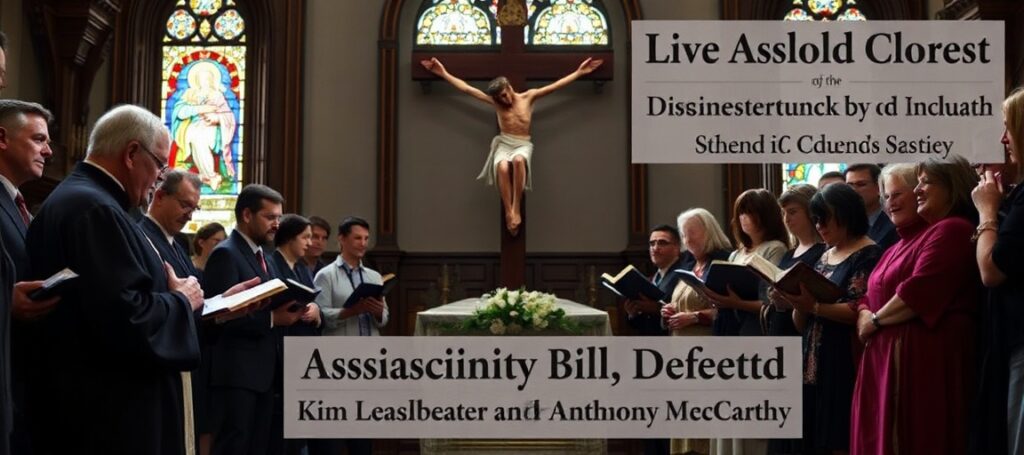
A Catholic priest and laity pray in a church against the defeat of an assisted-suicide bill.
World

UK Pro-Life Victory Exposes the Bankruptcy of “Autonomy” and the Culture of Death

The National Catholic Register portal reports that on April 24, 2026, proposed legislation to legalize assisted suicide in England and Wales — the Terminally Ill Adults (End of Life) Bill, introduced by Labour MP Kim Leadbeater — ultimately failed in the House of Lords after passing the House of Commons in June 2025 by a vote of 314 to 291. Pro-life organizations, including the Society for the Protection of Unborn Children (SPUC) and Right to Life UK, hailed the outcome as a “great victory,” noting that hundreds of amendments introduced in the Lords exposed the bill’s flaws and that public support for assisted suicide has since decreased. The bill expired due to the lack of parliamentary time rather than a final vote. However, pro-life campaigners warn that similar legislation could be reintroduced in the next parliamentary session. The article quotes Anthony McCarthy of the Bios Centre, who emphasized threats to vulnerable patients, conscience protections, and the importance of palliative care. This apparent victory, however, must be measured against the abject spiritual and doctrinal collapse of the very Catholic institutions that should be leading the fight for the Faith — and the article’s own silence on the true nature of the conciliar sect’s complicity in the culture of death.

A devout Catholic family praying together in a modest home with a crucifix and traditional catechism book.
Antichurch

Chastity Formation Letter: Catholic Virtue Diluted by Naturalistic Psychology and Conciliar Ambiguity

National Catholic Register portal (April 24, 2026) published a commentary by Father Carter Griffin, rector of St. John Paul II Seminary in Washington, D.C., titled “Forming Your Children for Chastity: A Letter to Parents.” The article addresses the urgent question of how Catholic parents can form their children in holy purity in an age saturated with pornography, social media, and digital addiction. Father Griffin identifies the primary threats to chastity as the “attention economy” of Silicon Valley, the ubiquity of smartphones, and the toxic allure of online pornography, noting that the average age of first exposure is between 9 and 12 years old. He offers three main pieces of counsel: fostering regular, positive, and honest conversations about chastity from an early age; implementing strict governance over screen usage, including keeping bedrooms screen-free and monitoring app consumption; and nurturing the child’s imagination through contact with three-dimensional reality such as sports, books, and family activities. He concludes by emphasizing the importance of the spousal relationship as a model of chastity, the role of the sacraments and adoration, and the cultivation of self-restraint in daily life. While the article presents itself as a practical guide for Catholic families, it operates almost entirely within a naturalistic and psychological framework, reducing the supernatural virtue of chastity to a matter of behavioral management and parental technique, while remaining conspicuously silent on the theological gravity of sin, the necessity of confession, the reality of the devil, and the doctrinal chaos of the post-conciliar era that has made the formation of children in purity a near-impossible task for the average Catholic family.

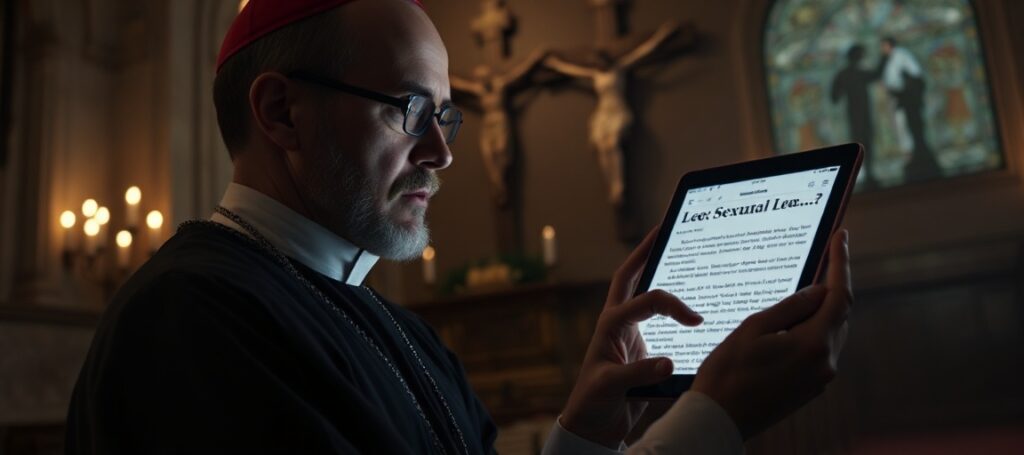
A devout Catholic man reading a paywalled article on a tablet in a dimly lit chapel, expressing dismay at the commodification of Catholic truth.
Antichurch

The Pillar’s Paywalled Silence: When Catholic News Becomes a Commodity

The Pillar portal, in its April 24, 2026 edition of “The Friday Pillar Post,” offers a brief, paywalled audio summary of recent news. Written by Ed Condon, the post itself contains virtually no substantive content — merely promotional material directing subscribers to audio recordings and podcast platforms. The show notes cryptically reference “Leo: Sexual…” before cutting off, a fragment suggesting coverage of the ongoing sexual abuse crisis within the conciliar structures. The article’s total written content amounts to fewer than one hundred words of actual text, the rest being subscription prompts, podcast setup instructions, and links to other episodes. This is not journalism; it is a marketing funnel dressed in ecclesiastical vestments.

A Catholic priest in traditional vestments looks disheartened as he gazes at an AI interface named 'Maria,' symbolizing the Diocese of Bridgeport's shift from supernatural mission to technological modernity.
Antichurch

When Machines Replace Souls: The Diocese of Bridgeport’s Abandonment of the Supernatural Mission

EWTN News reports that the Diocese of Bridgeport, Connecticut, has introduced an artificial intelligence tool named “Maria,” described as the “world’s first virtual engagement officer,” designed to solicit donations and engage with local Catholics. Bishop Frank Caggiano praised the initiative as a means to “deepen our listening and foster more personal responses,” while Deacon Patrick Toole, former IBM executive, framed it as an opportunity to use technology “for the good of the mission.” The diocese claims this AI is “rooted in the Church’s mission” and will not replace human relationships but rather “bridge the gap” in communication. This move represents a profound abdication of the Church’s supernatural character, reducing the sacred work of evangelization and pastoral care to algorithmic automation, symptomatic of the conciliar sect’s modernist embrace of secularism and its abandonment of immutable Catholic truth.

A reverent Catholic school classroom with a prominent display of the Ten Commandments, symbolizing the divine authority of God's Law in education.
Antichurch

The Ten Commandments Ruling Exposes the Bankruptcy of Secular “Religious Liberty”

The National Register commentary by Andrea M. Picciotti-Bayer celebrates a 5th Circuit Court ruling upholding Texas’ law requiring passive display of the Ten Commandments in public schools. The author praises Judge Kyle Duncan’s opinion as restoring “proper moorings” to Establishment Clause analysis, arguing that the ruling aligns with the nation’s “history and tradition” and that the specific text used is “nonsectarian” and compatible with Catholic teaching. The commentary frames this as a victory against decades of anti-religious judicial activism, particularly the Lemon test, and dismisses concerns about denominational bias or religious coercion. While superficially appealing to Catholic sensibilities, this commentary reveals a profound theological and spiritual bankruptcy, masking a dangerous capitulation to secularism and the very modernist errors that have hollowed out the Church’s public witness.

A reverent Catholic classroom with students of various abilities learning under the guidance of a nun in traditional habit, emphasizing faith and charity in education.
Antichurch

Catholic Schools and the Secularization of Mercy: Inclusion Without Truth

The Pillar portal reports on a new survey from the National Catholic Partnership on Disability (NCPD), revealing that Catholic schools in the United States vary widely in their inclusion of students with disabilities. While nearly half a century has passed since the U.S. Conference of Catholic Bishops issued its 1978 pastoral note calling for integration, the report finds persistent inconsistency, lack of funding, insufficient training, and—most damningly—a lingering attitude among some Catholic school leaders that serving children with special needs is optional. Dr. Colleen McCoy-Cejka, author of the report, expressed hope that progress is being made, citing increases in schools serving students with intellectual disabilities and offering professional development. Yet the very need for such a survey, and the admission that inclusion remains uneven and often superficial, exposes a deeper crisis: the reduction of Catholic education to a secular framework of “inclusion” divorced from the supernatural mission of the Church and the immutable truths of the Faith.

Scroll to Top
Antichurch.org
Privacy Overview

This website uses cookies so that we can provide you with the best user experience possible. Cookie information is stored in your browser and performs functions such as recognising you when you return to our website and helping our team to understand which sections of the website you find most interesting and useful.