Author name: amdg

A solemn scene in St. Peter's Square on Divine Mercy Sunday 2026, depicting Leo XIV (Robert Prevost) addressing a divided crowd under a stormy sky.
Antichurch

The Usurper’s Empty Peace: Leo XIV Preaches Humanitarianism While the World Burns in Apostasy

On Divine Mercy Sunday, April 12, 2026, the occupant of the Vatican throne, Leo XIV (Robert Prevost), addressed the faithful gathered for the Regina Caeli prayer in St. Peter’s Square, renewing appeals for ceasefires in Ukraine, Lebanon, and Sudan. Speaking from the heart of the conciliar sect, he invoked the “principle of humanity” and “international law” as the basis for protecting civilians, urging warring parties to pursue “peaceful solutions.” He also reflected on the Gospel reading for the Second Sunday of Easter, emphasizing the necessity of the “Sunday Eucharist” for Christian life and recalling the Martyrs of Abitene, who preferred death over renouncing the celebration of the Lord’s Day. Before concluding, he announced his upcoming apostolic journey to Africa—Algeria, Cameroon, Angola, and Equatorial Guinea. This address, while cloaked in the language of piety, is a textbook example of the post-conciliar substitution of supernatural charity with naturalistic humanitarianism, reducing the Church’s mission to that of a global NGO pleading before the idols of secular geopolitics.

Cardinal McElroy delivering a homily at St. Matthew's Cathedral in Washington, condemning the U.S.-Iran war as immoral. The scene reflects Catholic teaching on just war and political authority.
Antichurch

Cardinal McElroy’s “Peace” Obediently Serves the Revolution’s Agenda

National Catholic Register portal reports that Cardinal Robert McElroy of Washington celebrated a “Mass for peace” on April 11, 2026, at the Cathedral of St. Matthew the Apostle, in response to the appeal of the antipope Leo XIV for prayer amid the conflict between the United States and Iran. In his homily, McElroy condemned the war as “morally illegitimate,” citing just-war principles, and called on citizens to oppose their own government: “Not in our name. Not at this moment. Not with our country.” The liturgy was part of a global observance of such “Masses for peace” following the antipope’s Easter appeal. This spectacle of a cardinal inciting citizens to defy their legitimate government in wartime is not an act of pastoral courage but a textbook example of the post-conciliar Church’s subordination of supernatural faith to temporal political agendas, a direct fruit of the revolution inaugurated by John XXIII and the antipopes who followed him.

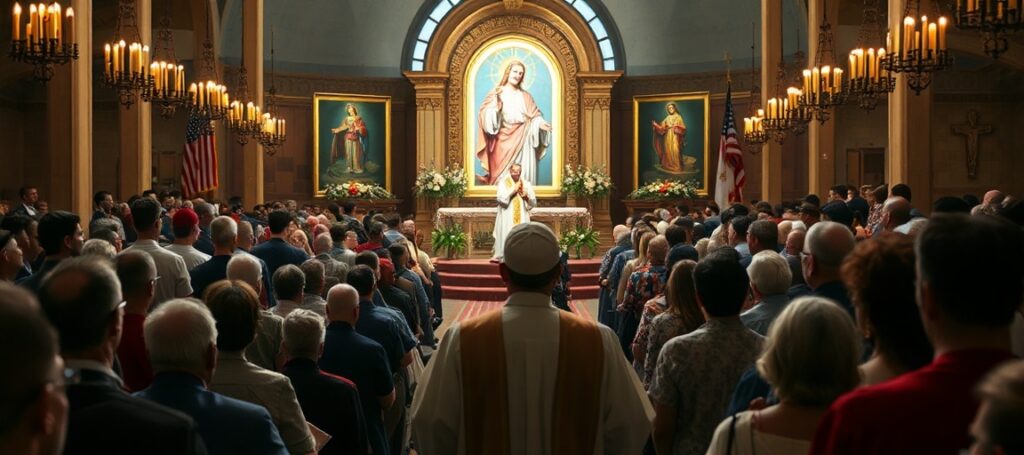
A solemn Catholic scene depicting the Divine Mercy Shrine in Hollywood with a crowd gathered for Divine Mercy Sunday.
Spiritual

Divine Mercy Devotion in Hollywood: A Beacon of False Mysticism and Conciliar Apostasy

National Catholic Register portal reports on the growing popularity of the so-called “Divine Mercy Shrine” in Hollywood, describing it as a “beacon of hope” drawing crowds for Divine Mercy Sunday. The article highlights statements by Father Juan Ochoa, rector of the shrine, who emphasizes themes of reconciliation, peace, and unity — all framed within the post-conciliar paradigm of naturalistic humanism devoid of supernatural truth. The piece celebrates the shrine’s centennial, its recognition by Archbishop José Gomez, and the veneration of an image allegedly blessed and signed by John Paul II — a figure whose canonization and theological legacy are deeply suspect from the perspective of integral Catholic faith.

World

When Diplomacy Replaces Divine Order: The Bankruptcy of a World Without Christ the King

VaticanNews portal reports that United States and Iranian delegations have failed to reach an agreement following peace talks held in Islamabad, with U.S. Vice President JD Vance declaring Washington’s proposal “our final and best offer” and Tehran’s Foreign Ministry urging America to avoid “excessive demands,” all unfolding in what Iran described as an atmosphere of “mistrust, suspicion and doubt.” The article notes that over 3,375 people have been killed in Iran since the commencement of U.S. and Israeli military strikes, including hundreds of children, among them seven infants under one year old, and that about one-fifth of Lebanon’s population remains displaced. The portal presents these grim statistics with the detached tone of secular journalism, offering no theological framework whatsoever for understanding the catastrophe — a silence that is itself the most damning indictment of the conciliar sect’s complete abandonment of the Church’s divine mission to proclaim the social reign of Christ the King over all nations.

Antichurch

The Augustinian Mirage: How the Neo-Church Weaponizes St. Augustine Against the Faith

Vatican News portal reports on an interview with philosopher James K. A. Smith, who discusses St. Augustine’s “existential dimension,” “refugee spirituality,” and the saint’s supposed relevance to modern political questions ahead of the apostate Leo XIV’s trip to Algeria. The article presents Augustine as a figure of “interiority,” “subjectivity,” and openness to migrants, while ignoring the saint’s unequivocal teaching on the necessity of the Catholic Church for salvation, the duty of states to uphold the true religion, and the absolute primacy of supernatural truth over naturalistic humanitarianism. The thesis of this analysis is that the conciliar sect systematically distorts the Church Fathers, particularly St. Augustine, to legitimize its apostate agenda of religious indifferentism, false mercy, and the dissolution of Catholic doctrine into secular humanism.

Antichurch

The “Catholic” Peace of the Neo-Church: A Modernist Surrender to the Kingdom of Man

EWTN News portal reports on the collapse of U.S.-Iran peace talks and the subsequent calls for peace by the conciliar sect’s leadership, including the antipope Leo XIV and “Cardinal” Robert McElroy. The article presents a superficial narrative of diplomatic failure and moral pleading, utterly devoid of the supernatural framework that alone can address the root causes of war: sin and the rejection of Christ the King. While the world burns, the neo-church offers nothing but sentimental platitudes and a dangerous, naturalistic pacifism that betrays the integral Catholic faith.

Babe Ruth kneeling in prayer before a Catholic altar holding a Miraculous Medal.
Spiritual

Babe Ruth’s Deathbed Return: A Testament to Catholic Grace Amid a World of Vanity

The National Catholic Register recounts the story of baseball legend George Herman “Babe” Ruth’s lifelong connection to the Catholic faith, his dramatic return to the sacraments before death, and his devotion to the Miraculous Medal. The article, originally from ChurchPop, portrays Ruth’s journey from a wayward life of excess to a final reconciliation with God through confession and Holy Communion before his death in 1948. While the narrative celebrates Ruth’s Catholic identity and his reliance on sacramentals, it glosses over the profound theological gravity of his decades-long estrangement from the Church and the spiritual peril inherent in treating the faith as merely a sentimental comfort rather than the singular path to salvation.

A critical depiction of the Vilnius Divine Mercy Shrine, highlighting its modernist influences and theological errors.
Antichurch

The Divine Mercy Devotion: A Mystical Fraud at the Heart of the Conciliar Revolution

The National Catholic Register portal reports on the Vilnius Divine Mercy Shrine, the center of the devotion built around the figure of St. Faustina Kowalska and the “Merciful Jesus” image. The article describes the shrine’s 24-hour adoration, the Sisters of Merciful Jesus, and the upcoming World Apostolic Congress on Mercy in June 2026. It presents the devotion as a legitimate expression of Catholic piety, focusing on mercy, trust, and the sacraments. This sentimental narrative masks a profound theological fraud that has become one of the most effective tools of the modernist revolution against the true faith.

Bishop in liturgical vestments stands before a closed Cuban church with kneeling faithful Catholics in prayer.
Antichurch

Florida Bishop’s Appeal for Cuba Exposes the Bankruptcy of Conciliar Diplomacy

EWTN News reports that Bishop Manuel de Jesús Rodríguez of Palm Beach, Florida, during an interview following his March visit to Cuba, advocated for “greater internet access,” “political freedom,” and “freedom of expression” for Cubans, framing these demands as matters of “human dignity.” He described the release of over 2,000 prisoners by the communist regime as “a first step” and called for “dialogue and collaboration” with the Cuban authorities, assuring them that the Catholic Church “is no one’s enemy” and is not “married to any ideology.” This appeal, while cloaked in pastoral language, reveals the profound theological and strategic bankruptcy of the post-conciliar approach to communist tyranny—an approach rooted not in the unchanging doctrine of the Church but in the modernist errors condemned by the pre-1958 Magisterium.

A somber Catholic chapel with a laptop displaying an AI interface, reflecting spiritual desolation and the dangers of technological idolatry in the conciliar sect, featuring a disillusioned young man and a concerned traditional priest.
Antichurch

Acutis AI: Digital Idolatry in the Service of the Conciliar Sect

EWTN News portal reports that two college students, Peter and Thomas Cooney, have launched an AI platform called “Acutis AI,” named after the conciliar sect’s so-called “saint” Carlo Acutis, aiming to provide artificial intelligence responses shaped by what they call “Catholic teaching.” The platform uploads the post-conciliar Catechism, encyclicals, and the Summa Theologica into its code, restricts moral questions to these sources, and offers parental monitoring features. The creators claim this addresses the dangers of mainstream AI platforms that allegedly remain “neutral” on moral issues such as abortion. This entire enterprise, however, is a textbook example of the conciliar sect’s characteristic reduction of the Catholic faith to a programmable moral code, a digital golden calf dressed in the language of piety, and a symptom of the profound spiritual bankruptcy of post-conciliarism, which seeks technological solutions to problems rooted in the abandonment of true doctrine and the supernatural life.

Scroll to Top
Antichurch.org
Privacy Overview

This website uses cookies so that we can provide you with the best user experience possible. Cookie information is stored in your browser and performs functions such as recognising you when you return to our website and helping our team to understand which sections of the website you find most interesting and useful.