
Author name: amdg

Antichurch

Conciliar Church’s “Justice” Demand Betrays Christ the King for Secular Rights

The EWTN News article from February 23, 2026, reports that Archbishop Victor Henry Thakur of Raipur, India, welcomed a Supreme Court interim order halting the forced exhumation of tribal Christians’ remains by Hindu fundamentalist groups but declared “Relief is not enough. We want justice.” The archbishop criticized the court’s refusal to overturn a ruling allowing village notice boards banning pastors and “converted Christians,” calling it discriminatory and a violation of constitutional rights to free movement and propagation of religion. The United Christian Forum described the situation as “No Rest Even in Death for Christians in India,” citing social boycotts, denial of water and rations, and frequent assaults. The article frames the crisis in terms of constitutional “rights” and “justice” sought through secular courts, omitting any reference to the supernatural kingship of Christ, the duty of Catholic states to recognize the Catholic Church, or the sacramental life of the Church. This perspective fundamentally rejects the integral Catholic social order proclaimed by pre-1958 magisterial teaching.
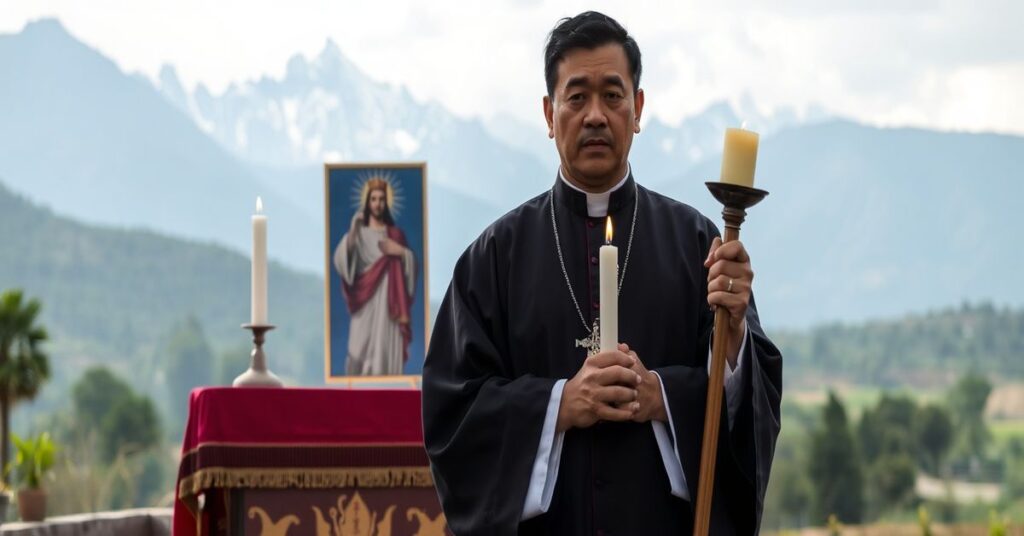
A solemn Catholic figure in traditional attire stands before an altar with an image of Christ the King, set against the backdrop of Nepal's Himalayan mountains.
Antichurch

Nepal’s Catholic Leader Preaches Political Engagement Without Christ the King

The apostolic administrator of the Vicariate Apostolic of Nepal, Mr. Silas Krishna Bogati, has urged the country’s Catholics to vote “wisely” in the upcoming March 5 parliamentary elections, framing political participation as a civic duty to bring “positive political change.” This appeal, issued from a post-conciliar ecclesiastical structure, operates entirely within the naturalistic framework of modern democracy, utterly divorced from the Catholic doctrine of the Social Kingship of Christ. It exemplifies the radical rupture with integral Catholic teaching that defines the post-1958 “Church.” The article presents this engagement as unremarkable, yet its silence on the absolute necessity of the public recognition of Jesus Christ as King of nations constitutes a damning admission of apostasy.

Antichurch

Filipino Bishops Promote Interfaith Naturalism During Lent

The EWTN news portal reports that two Filipino bishops—Bishop Jose Colin Bagaforo and Archbishop Alberto Uy—have issued statements calling for greater Muslim-Christian solidarity and peace as Lent and Ramadan begin nearly simultaneously in February 2026. Bagaforo, chairman of the Catholic Bishops’ Conference of the Philippines’ (CBCP) Episcopal Commission on Interreligious Dialogue, described the shared timing as “a grace” that invites people to “slow down, to return to God, and to walk together in faith.” Uy, installed as archbishop of Cebu in September 2025, emphasized common humanity across religious lines, stating: “No matter what religion we are… we all share one basic truth: We are all brothers and sisters in our humanity.” Both prelates framed interfaith cooperation as a means to build peace, protect human dignity, and respond to conflict with understanding, while acknowledging the Philippines’ history of religious tension between the Christian majority and Muslim minority. The article notes that Muslims comprise an estimated 6–11% of the population, with most living in Mindanao, where decades of conflict have shifted from armed struggle to negotiation, culminating in the creation of the Bangsamoro Autonomous Region. A statement from the National Commission on Muslim Filipinos echoed the theme of patience and compassion during the sacred seasons. The bishops’ messages contain no reference to the exclusive salvific role of the Catholic Church, the necessity of converting non-Catholics, or the social reign of Christ the King over all nations.

Scroll to Top
Antichurch.org
Privacy Overview

This website uses cookies so that we can provide you with the best user experience possible. Cookie information is stored in your browser and performs functions such as recognising you when you return to our website and helping our team to understand which sections of the website you find most interesting and useful.