Antichurch

Antichurch

The Illusion of Accountability: Vos Estis Lux Mundi and the Theater of Reform

The Pillar portal reports on the seventh anniversary of the motu proprio Vos estis lux mundi, a document promulgated by the antipope Francis in 2019, ostensibly to address clerical sexual abuse and episcopal negligence. The article, authored by JD Flynn, questions whether the policy could be more effective if it led to publicly known consequences beyond mere removal from office. It cites initial praise from Cardinal Daniel DiNardo and Cardinal Sean O’Malley, who claimed the document would bring “predators to justice” and ensure “transparency, and accountability.” However, the article admits that “transparency has not been a feature” of its implementation, and results are only visible when bishops resign—often under the pretext of “health reasons.” Flynn suggests that the binary outcome (resignation or nothing) limits the tool’s effectiveness and proposes alternatives such as the “Hunthausen solution” (appointing a coadjutor to oversee specific areas) or public apologies for administrative failures. The article concludes that a broader range of responses might restore trust among Catholics and foster “a continuous and profound conversion of hearts.”

The fundamental error of this analysis lies in its complete acceptance of the conciliar sect’s framework as legitimate, treating a document issued by an antipope as if it were a valid exercise of papal authority, and proposing reforms within a structure that is itself the product of modernist apostasy. The very premise—that the Church needs new mechanisms for “accountability”—reveals a naturalistic, bureaucratic mindset that reduces the supernatural society established by Christ to a mere human corporation requiring managerial oversight.

Antichurch

The Pillar’s Paywalled Silence: A Conciliar Portal With Nothing Catholic to Say

The Pillar portal reports, behind a paywall, its “Friday Pillar Post” for June 19, 2026 — a podcast episode authored by Ed Condon, offering audio recordings of news from the conciliar sect’s media apparatus. The content is accessible only to paid subscribers, a fitting metaphor for the entire post-conciliar enterprise: the faithful must pay for access to information about an institution that has emptied itself of all supernatural substance. The cited article relates to a podcast summary of ecclesiastical news from structures occupying the Vatican, presented as journalism but functioning as propaganda for the neo-church of the Antichrist. That a Catholic-sounding portal in 2026 has reduced itself to monetized audio snippets — devoid of any mention of the Most Holy Sacrifice, the state of grace, the reality of sin, or the eternal destiny of souls — is itself the most damning indictment of the spiritual bankruptcy of post-conciliarism.

Antichurch

The Neo-Church Co-opts AI Discourse While Silencing the Supernatural

National Catholic Register reports on Artur Kluz, a Catholic tech investor who claims that Pope Leo XIV’s encyclical *Magnifica Humanitas* has sparked unprecedented interest in the Church’s moral vision among Silicon Valley elites. Kluz envisions a new order of Christian “knights” from the tech world to guide the Church through the age of artificial intelligence, asserting that technology is a mirror of its creators and that wisdom must prevail over power. Yet beneath this veneer of engagement lies a profound omission: the article, and the vision it promotes, remains entirely silent on the supernatural mission of the Church, the necessity of sanctifying grace, the reality of original sin, and the absolute primacy of the salvation of souls over technological progress. Instead, it reduces the Church’s role to that of a moral consultant to secular power structures—precisely the error condemned by St. Pius X in *Lamentabili sane exitu* and by Pius XI in *Quas Primas*.

Antichurch

Synodality and the New Jerusalem: Leo XIV’s Blueprint for Globalist Idolatry

The National Catholic Register portal reports that on June 19, 2026, the usurper Robert Prevost, styling himself “Pope Leo XIV,” addressed participants of the so-called “Borgo Dialogues” at the Vatican, praising their commitment to the “ecological, social, and economic transformation of the world” grounded in the conciliar sect’s vision of “synodality.” Drawing on his encyclical Magnifica Humanitas, he urged resistance to the “Tower of Babel” of profit idolatry while calling for the construction of a “New Jerusalem” and a “civilization of love” as the guiding principle of economic, political, and cultural life. This address is not merely another diplomatic platitude from the occupant of the Vatican; it is a concentrated distillation of every modernist error condemned by the true Magisterium — a manifesto for the replacement of the supernatural order with a naturalistic, globalist humanism dressed in theological vestments.

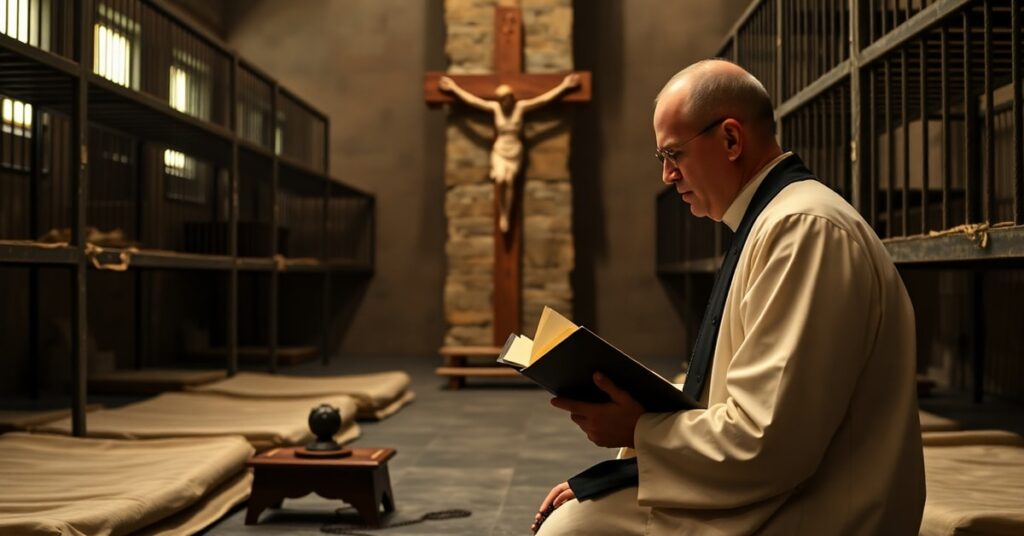
A Catholic priest kneeling in prayer before a crucifix in a prison cell, symbolizing the abandonment of incarcerated Catholics in the post-conciliar Church.
Antichurch

Ecclesiastical Dark Matter and the Abandonment of the Imprisoned Flock

The Pillar portal reports on a June 19, 2026, article by Ed. Condon, which begins with a reflection on the precariousness of human life and the author’s personal spiritual struggles between “fatalism” and “petitioning the Almighty over daily trivialities.” The article then transitions to news items, including an Italian archbishop accused of antisemitism for petitioning against an Israeli novelist, a Kansas priest arrested for embezzling parish funds, and the appointment of a new nuncio to Germany. A significant portion of the article focuses on a presentation at the U.S. bishops’ conference regarding the estimated 400,000 incarcerated Catholics in the United States, described as “ecclesiastical dark matter,” and the profound lack of pastoral care and sacramental access they receive. The article concludes by drawing a parallel between this forgotten population and a “diocese” in canonical terms, lamenting their marginalization. While the article superficially acknowledges the need for pastoral contact, it fundamentally fails to address the root causes of this abandonment within the post-conciliar structures, nor does it offer a truly Catholic solution grounded in the Church’s immutable social teaching and the necessity of the Most Holy Sacrifice.

Antichurch

Synodality: The Neo-Church’s Blueprint for Globalist Idolatry

EWTN News Vatican Bureau reports that on June 19, 2026, the antipope Leo XIV (Robert Prevost) addressed participants of the so-called “Borgo Dialogues” at the Vatican, praising “synodality” as a means to promote the “common good” and avoid “new divisions.” The article describes how Leo XIV drew upon his encyclical *Magnifica Humanitas* — itself a product of the conciliar sect’s obsession with artificial intelligence and secular progressivism — to urge leaders to resist the “idolatry of profit” and instead build a “civilization of love” termed the “New Jerusalem.” The Borgo Dialogues, held at the Borgo Laudato Si’ in Castel Gandolfo from June 17–19, brought together leaders from academia, culture, and business to discuss global ecological challenges inspired by the apostate Francis’ encyclical *Laudato Si’*. This event is yet another manifestation of the post-conciliar neo-church’s systematic replacement of the supernatural mission of the Catholic Church with a naturalistic, globalist, and Masonic program of “ecological, social, and economic transformation.” The thesis of this critique is that Leo XIV’s address represents not a call to authentic Catholic unity, but a further entrenchment of the conciliar sect’s apostate project: the substitution of the Kingdom of Christ the King with a humanitarian Tower of Babel dressed in the language of “synodality” and “civilization of love.”

Antichurch

Neocatechumenal Missionary Spectacle: A Charismatic Farce Masquerading as Providence

VaticanNews portal reports on a retreat organized by the Neocatechumenal Way in Porto San Giorgio, Italy, where approximately 800 priests—many formed in the Redemptoris Mater missionary seminaries across the Americas—are preparing for a “missionary experience” involving a four-day evangelization effort “without carrying any money.” Msgr. Renato Grasselli, rector of the Redemptoris Mater Seminary in Newark, describes this as a “concrete encounter with Divine Providence,” while expressing joy that participants will attend “the Pope’s General Audience” next Wednesday. The entire spectacle, framed as a joyful proclamation of the Gospel, is in reality a carefully choreographed display of charismatic theatrics that substitutes emotional experience for the supernatural life of grace, reduces the Church’s mission to naturalistic activism, and reinforces the conciliar sect’s systematic dismantling of authentic Catholic missionary theology.

Antichurch

The Conciliar Sect’s Manufactured “Conversion” Statistics Expose Evangelistic Bankruptcy

Vatican News portal (June 19, 2026) reports on a study of 2,127 participants in the Order of Christian Initiation of Adults (OCIA) across 20 U.S. dioceses, claiming growing interest in the Catholic faith driven by “search for truth, purpose and community.” The study, conducted by the Archdiocese of Chicago in collaboration with 19 other dioceses, found that 77% of participants cited a desire to grow in virtue, 76% sought deeper understanding of truth, and 72% reported searching for inner peace. The report emphasizes digital evangelization, personal accompaniment, and creating “welcoming communities” as key strategies. This study, however, reveals not the vitality of the faith but the profound theological and spiritual bankruptcy of the post-conciliar apparatus, which has replaced the supernatural mission of the Church with naturalistic humanism and statistical self-congratulation.

Antichurch

Hermits in the Desert: A Diocesan Foundation Under the Usurper’s Shadow

The article from EWTN News (June 19, 2025) reports on the establishment of a new community of hermits, the “Hermits of Sts. Torquatus, Martha, Mary, and Lazarus,” in the Diocese of Guadix, Spain. Four Venezuelan men, Carlos Andrés, Óscar Eduardo, Osmar Moisés, and Emilio José, have taken up residence at the historic hermitage of St. Torquatus, a site associated with the first-century martyrdom of one of the apostle James’s disciples. The foundation, initiated by “Bishop” Francisco Jesús Orozco, aims to “keep the memory of the place alive” and “pray for the Church proclaimed by St. Torquatus,” with a particular focus on “perpetual adoration of the Blessed Sacrament” and intercession “for the needs of our Holy Father, the pope.” The ceremony consecrating the hermits was attended by members of the “Congregation of Martha and Mary,” a community of women religious. While the narrative presents a seemingly pious endeavor, the entire framework operates within the structures of the post-conciliar neo-church, rendering its spiritual claims suspect and its “prayers for the pope” a direct intercession for the usurper Leo XIV, the chief architect of modernist apostasy.

Scroll to Top
Antichurch.org
Privacy Overview

This website uses cookies so that we can provide you with the best user experience possible. Cookie information is stored in your browser and performs functions such as recognising you when you return to our website and helping our team to understand which sections of the website you find most interesting and useful.