
Antichurch

Antichurch

The Rosary Spectacle: Leo XIV’s Barcelona Theater Exposes the Conciliar Sect’s Obsession with Sentiment Over Sacrament

EWTN News reports that during Leo XIV’s visit to the Shrine of Our Lady of Montserrat near Barcelona on June 10, 2026, a young Catalan man named Sergi handed his rosary to the antipope, who pocketed it and then used it to pray before returning it by tossing it from his car window — a scene the young man called “the greatest gift we could have received.” This anecdote, breathlessly relayed by Catholic media, reveals far more than a heartwarming encounter: it exposes the theological bankruptcy, the cult of personality, and the superstitious sacramentalism that define the post-conciliar sect.
Antichurch

The Usurper’s Spanish Spectacle: Leo XIV’s Barcelona Pilgrimage Exposes the Bankruptcy of the Conciliar Sect

EWTN News reports that Robert Prevost, who falsely claims the title “Pope Leo XIV,” continued his seven-day tour of Spain on June 10, 2026, visiting Barcelona for a prayer vigil at Lluís Companys Olympic Stadium, a visit to Brians 1 Prison, a stop at the Abbey of Our Lady of Montserrat, and Mass at the Sagrada Familia Basilica, before proceeding to the Canary Islands to conclude his trip on June 12. The report describes the “Holy Father” greeting crowds, blessing ambulances, meeting students, and celebrating what it calls “Mass” at the famed Gaudí church. What EWTN News dutifully chronicles as a pastoral triumph is, in reality, a meticulously staged spectacle by the head of the conciliar sect — a man who occupies Peter’s throne without legitimate authority — revealing the total inversion of the Church’s mission into a theater of humanitarianism, religious indifferentism, and the cult of man.

Antichurch

Human Dignity Without Christ: The Neo-Church’s Substitution of Naturalism for Supernatural Truth

VaticanNews portal reports on June 11, 2026, that the usurper Robert Prevost, styling himself “Pope Leo XIV,” delivered a speech at the port of Arguineguín in Gran Canaria during his so-called “Apostolic Journey to Spain,” declaring that “human dignity has no passport and does not lose its value when crossing a border.” The article describes his meeting with migrants, rescuers, and volunteers, his denunciation of human trafficking, his call for “legal and safe migration pathways,” and his appeal to governments and international institutions for “solidarity” and “shared responsibility.” He invoked Matthew 25, spoke of the “right not to migrate,” and concluded with the rhetorical question: “What remains of our humanity?” This spectacle represents yet another manifestation of the conciliar sect’s systematic replacement of the supernatural order with naturalistic humanism, reducing the Church’s divine mission to a humanitarian NGO operating within the framework of secular “human rights” ideology.

Antichurch

Migrants Serving Migrants: The Conciliar Substitution of the Supernatural Mission with Naturalistic Humanism

Vatican News portal reports on the visit of the antipope Leo XIV to the Church of Sant Agustí in Barcelona’s El Raval neighborhood, where four Augustinian clergy — two Filipinos and two Tanzanians — serve a parish nicknamed the “Cathedral of the Poor.” The article presents a portrait of a “multicultural parish” that ministers to migrants from Asia, Latin America, and North Africa, featuring devotions tailored to various ethnic communities, a soup kitchen run by the Missionaries of Charity, and the antipope’s encounter with diocesan charities. Beneath the veneer of pastoral solicitude lies a comprehensive exposition of the conciliar revolution’s reduction of the Church’s supernatural mission to mere naturalistic humanitarianism — the substitution of the salvation of souls with the feeding of bodies, the replacement of Catholic evangelization with multicultural relativism, and the transformation of the priestly office into that of a social worker.

Antichurch

Consecration to the Sacred Heart: A Neo-Church’s Ritual Without Repentance

The NC Register portal reports that on June 11, 2026, the bishops of the United States gathered at the Basilica of Our Lady Queen of the Universe in Orlando to consecrate the country to the Sacred Heart of Jesus. Msgr. Roger Landry, in his commentary, presents this act as a moment of great spiritual significance, linking it to Leo XIII’s 1899 consecration of the world and the episcopal consecration of Ven. Fulton Sheen in 1951. He frames the event within the context of the 250th anniversary of American independence, suggesting it will ignite a renewed missionary zeal among U.S. Catholics. Yet beneath the veneer of piety lies a profound theological and spiritual bankruptcy, symptomatic of the post-conciliar apostasy that has reduced the Church’s supernatural mission to a sentimental, naturalistic gesture devoid of true conversion, doctrinal clarity, or fidelity to Tradition.

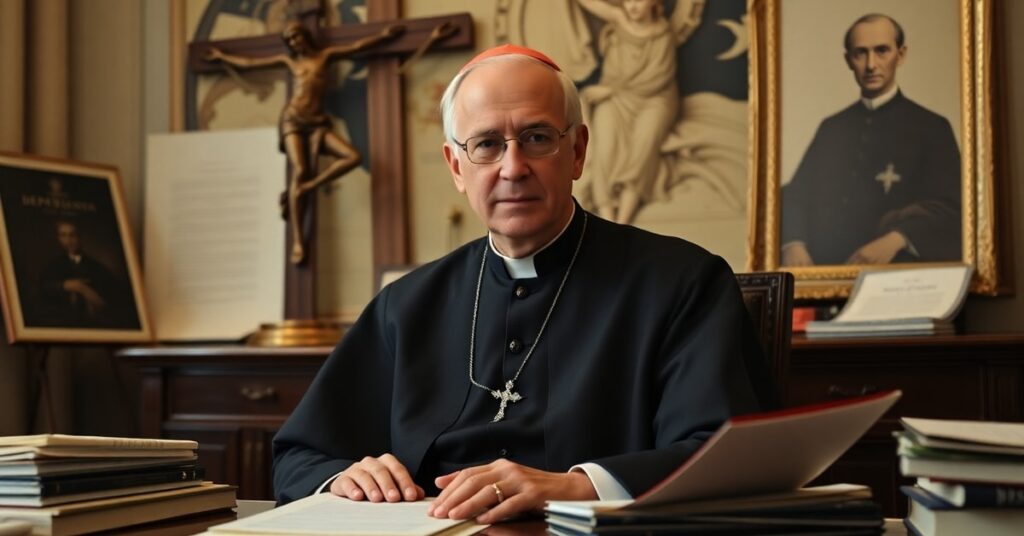
Cardinal Christophe Pierre in a Vatican office surrounded by modernist documents and symbols, contrasting with traditional Catholic imagery.
Antichurch

A Nuncio’s Farewell: Unmasking the Modernist Diplomacy of the Conciliar Sect

The National Catholic Register portal reports on the exit interview of Cardinal Christophe Pierre, the departing Apostolic Nuncio to the United States, who reflects on his decade-long tenure in Washington with a tone of diplomatic triumphalism. The interview reveals a prelate deeply embedded in the modernist project, boasting of dialogue with the “Department of War,” promoting the Aparecida document and the “prophetic” legacy of the Francis era, and reducing the Church’s mission to a geopolitical balancing act. What emerges is a portrait of a diplomat who has served not the immutable Kingdom of Christ, but the shifting political currents of the post-conciliar “Church of the New Advent,” where ideology and diplomacy replace dogma and supernatural truth.

Antichurch

The Conciliar Sect’s Education Crisis: When Imitation of the World Replaces the Mission of Forming Saints

National Catholic Register portal reports that on June 10, 2026, at the plenary assembly of the United States Conference of Catholic Bishops (USCCB) in Orlando, Santiago Schnell, provost of Dartmouth College and former dean at the University of Notre Dame, delivered a pointed address urging the bishops to take a more assertive role in safeguarding Catholic identity at Catholic universities. Schnell argued that Catholic institutions have become “indifferent and indistinguishable” from their secular counterparts, driven by the pursuit of college rankings and a reduction of education to mere job training. He called on bishops to be “more vocal” and “more pushy,” reminding them that they “own the word ‘Catholic,'” and proposed a three-part framework for renewal focused on forming intellectual leaders, clarifying the bishops’ role, and strengthening campus culture. The presentation preceded a closed-door conversation among the bishops on the state of Catholic higher education, marking the 25th anniversary of the U.S. implementation of Ex Corde Ecclesiae.

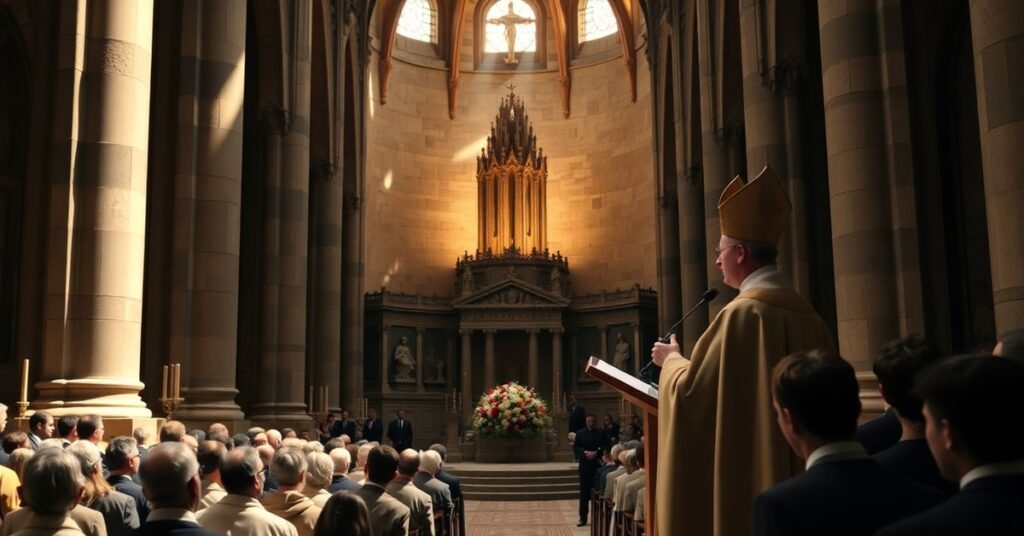
Antipope Leo XIV at Sagrada Família Basilica in Barcelona, surrounded by modernist architecture, delivering a hollow homily about unity and peace.
Antichurch

The “Tallest Church in the World”: A Monument to the Conciliar Cult of Man

EWTN News portal reports that on June 10, 2026, the antipope known as “Pope” Leo XIV traveled to Barcelona to inaugurate and bless the Tower of Jesus Christ atop the Sagrada Família Basilica, marking the centenary of the death of its architect, Antoni Gaudí. The event was presented as a moment of spiritual significance, with the “pope” delivering homilies about unity, peace, and the rejection of war. Yet beneath the veneer of piety lies a ceremony that perfectly encapsulates the conciliar revolution’s substitution of the worship of God with the glorification of human achievement, the elevation of architectural spectacle over the Most Holy Sacrifice of the Mass, and the reduction of the Church’s mission to a humanitarian NGO.

Antichurch

The Cockpit of Vanity: Leo XIV and the Theater of Self-Worship

EWTN News portal reports on the June 9, 2026, flight of the usurper Robert Prevost — who occupies Peter’s throne under the name “Leo XIV” — from Madrid to Barcelona, during which the antipope was invited into the cockpit of an Iberia aircraft and engaged in banter about Real Madrid football with the pilots. Co-pilot Ángeles Hernández described herself as being “on cloud nine,” attributing the encounter to “God’s ways” and a nun’s assurance that it was “the Lord’s way of telling me he loved me.” The article, dripping with sentimental euphoria, presents this trivial episode as though it were a spiritual event of the highest order. Beneath its saccharine surface lies a textbook case of the conciliar religion’s reduction of the sacred to the sentimental, the supernatural to the anecdotal, and the papal office to a celebrity meet-and-greet.

Antichurch

A Child’s Question Exposes the Bankruptcy of Conciliar Pastoral Theology

EWTN News reports on an encounter in Barcelona’s Raval neighborhood on June 10, 2026, where 6-year-old Renzo, a Peruvian migrant child living in poverty, asked Leo XIV: “Why do bad things happen to some people? And not to others? Whose fault is it? Why are there so many people living on the street? No one sees them, no one helps them.” The so-called pontiff responded with vague reassurances about God’s love, Jesus’ companionship, and eternal joy, while emphasizing social charity, forgiveness, and the loneliness of the elderly. The event was staged at a soup kitchen run by the Missionaries of Charity and the Mano Amiga Foundation, with the entire spectacle serving as a photo opportunity for the conciliar sect’s narrative of “touching human suffering” while remaining utterly silent on the supernatural causes of evil, the necessity of the Church’s true social teaching, and the apostasy that has rendered the post-conciliar institution incapable of answering even a child’s most fundamental theological question.

Scroll to Top
Antichurch.org
Privacy Overview

This website uses cookies so that we can provide you with the best user experience possible. Cookie information is stored in your browser and performs functions such as recognising you when you return to our website and helping our team to understand which sections of the website you find most interesting and useful.