Antichurch

Antichurch

Communist Martyr Narrative Serves Conciliar Revolution’s Political Agenda

EWTN News portal reports that Cardinal Michael Czerny, the Czech-born prefect of the Dicastery for Promoting Integral Human Development, delivered remarks at a conference titled “Blessed Martyrs Under Communism” hosted by the Czech Republic’s embassy to the Holy See. Czerny discussed the upcoming June 6 beatification of Fathers Jan Bula and Václav Drbola, two priests executed by the Czechoslovak communist regime in 1951–1952. The cardinal praised their “witness,” likened their sacrifice to “a grain of wheat” breaking through “the frozen ground of atheism,” and claimed their beatification fulfills Christ’s promise in Matthew 28:20. Pope Leo XIV approved the beatification in October 2025 alongside nine alleged Nazi martyrs. The entire narrative, however, functions not as authentic Catholic catechesis on martyrdom but as a political instrument of the conciliar sect, selectively weaponizing the memory of genuine suffering to legitimize the very modernist apparatus that has done more to destroy the Catholic faith than any communist regime ever could.
Antichurch

The Catechumenal Illusion: How the Conciliar Sect Mistakes Numbers for Grace

The Pillar Catholic portal reports on a “provincial ecclesial assembly” in France focused on the surge in adult baptisms, which more than doubled from 2023 to 2026, reaching 21,386 candidates. Organized by the Archdiocese of Paris and scheduled to run from May 2026 to May 2027, the gathering aims to address the integration of these “neophytes” through consultations involving tens of thousands of participants, including Protestants and Orthodox observers, and even utilizing AI for data analysis. While the article presents this as a sign of vitality, a closer examination reveals it as a textbook example of the post-conciliar obsession with external metrics and structural tinkering, utterly blind to the supernatural realities of faith, conversion, and the true mission of the Church.

Antichurch

Malta’s Political Minefield: Abortion, Euthanasia, and the Silence of Shepherds

National Catholic Register portal reports that ahead of Malta’s surprise general election on May 30, the Life Network Foundation has posed a direct yes-or-no question to the country’s six major political parties: will you support the introduction of abortion and voluntary assisted euthanasia in the next legislature? The Labour government under Prime Minister Robert Abela has already pledged a referendum on euthanasia if reelected, while remaining conspicuously silent on abortion. Meanwhile, the Dutch pro-abortion organization Women on Waves has installed approximately 15 “abortion lock safes” containing chemical abortion pill regimens across the island nation, brazenly violating Maltese law. That a nominally Catholic country — the only European nation with a near-total constitutional prohibition on abortion — finds itself in this position is not merely a political scandal; it is the inevitable fruit of decades of modernist infiltration, the abdication of pastoral authority, and the systematic dismantling of the social reign of Christ the King.

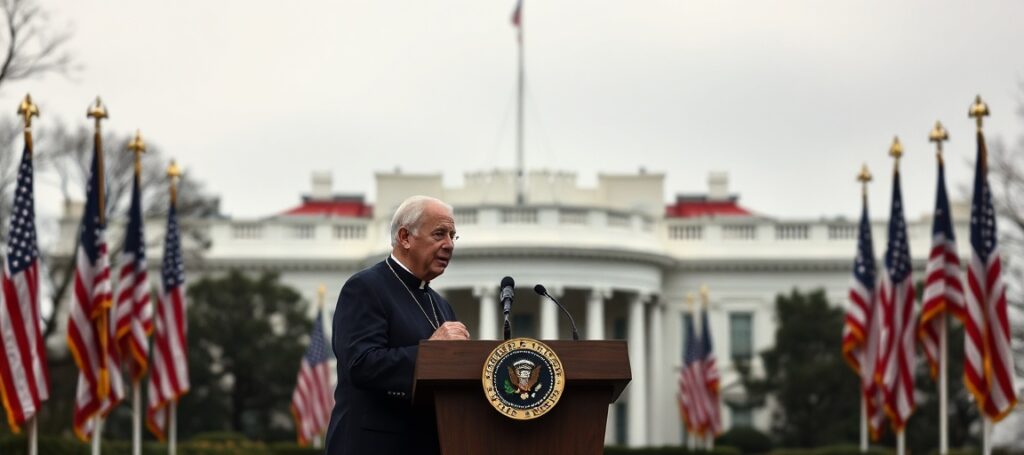
Bishop Robert Barron speaking at the White House about 'one nation under God' in a modernist context.
Antichurch

Bishop Barron’s “One Nation Under God” — A Masterclass in Modernist Capitulation to Secular Democracy

EWTN News portal reports that Bishop Robert Barron, a prominent figure in the post-conciliar structures occupying the Vatican, spoke at a White House event on May 17, 2026, celebrating the phrase “one nation under God” ahead of America’s 250th anniversary. In his interview with Colm Flynn, Barron praised the religious roots of the United States, invoked Abraham Lincoln’s Gettysburg Address, defended the First Amendment as an “eloquent balance,” encouraged Catholics in public office to bring “moral sensibility” without “imposing Catholicism,” described his role on the White House Religious Liberty Commission, addressed ICE detainees’ access to sacraments, criticized the president’s tone toward “the pope,” affirmed the just war tradition while deferring to civil authorities on prudential judgments, and called for “morally informed conversation” on immigration. This interview is a textbook example of the modernist bishop’s total capitulation to the secular liberal order, reducing the Catholic Faith to a private “moral sensibility” that may politely inform — but never govern — the public square, all while the abomination of desolation that is the conciliar sect masquerades as the Church of Christ.

A solemn Catholic priest in a traditional church, symbolizing the spiritual crisis caused by modern technology and apostasy.
Antichurch

Jesuit Spitzer’s AI Alarmism Masks the Real Crisis: A Church in Apostasy

National Catholic Register portal reports that Jesuit Father Robert Spitzer, in an EWTN interview, previewed four key areas he expects from the upcoming encyclical by the usurper Leo XIV on artificial intelligence: economic reconfiguration, autonomous warfare, cognitive decline in youth, and secular bias in search engines. Spitzer also highlighted tragic cases of teenagers committing suicide after interacting with AI chatbots, emphasizing the lack of conscience in secular AI models. While these concerns may appear superficially valid, the entire discourse unfolds within a framework that ignores the true moral and spiritual catastrophe: the systematic destruction of the Catholic Faith by the very structures now claiming to guide humanity through technological peril.

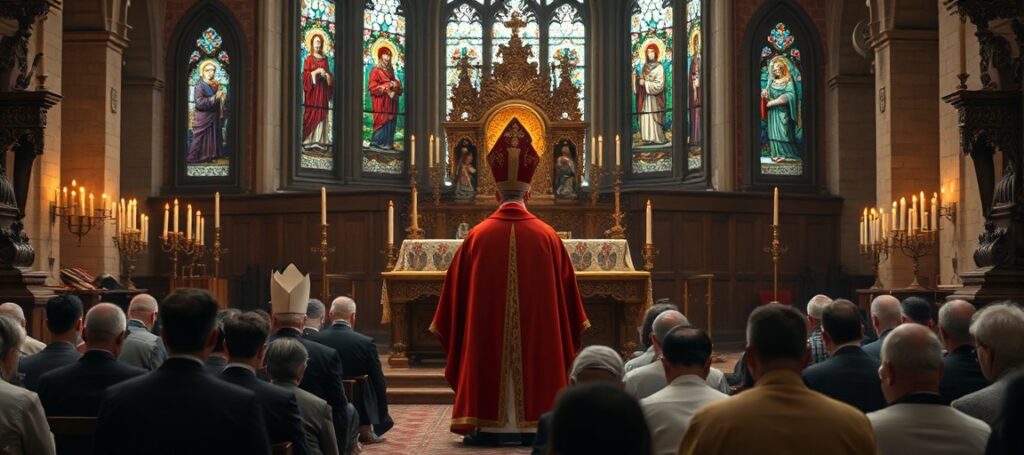
A traditional Catholic bishop in liturgical vestments stands before an altar with sacred relics, surrounded by kneeling faithful in a church with stained-glass windows depicting martyrdom.
Antichurch

Pope Leo XIV Authorizes Beatification of Maronite Patriarch and Spanish Civil War “Martyrs”

VaticanNews portal (May 22, 2026) reports that “Pope” Leo XIV authorized six decrees from the Dicastery for the Causes of Saints, paving the way for the beatification of Maronite Patriarch Elias Hoyek and 80 alleged martyrs of the Spanish Civil War, alongside four new “venerables.” This article exemplifies the conciliar sect’s systematic distortion of sanctity, martyrdom, and ecclesiology, substituting the supernatural order with naturalistic humanism and ecumenical indifferentism.

Leo XIV meets with Irish Taoiseach Micheál Martin in Vatican's Apostolic Palace, symbolizing the diplomatic theater masking Ireland's spiritual ruin.
Antichurch

Diplomatic Theater Masks Ireland’s Ecclesial Collapse

Vatican News portal reports that on May 22, 2026, the conciliar usurper Leo XIV received in audience the Taoiseach of Ireland, Mr. Micheál Martin, followed by meetings with Cardinal Pietro Parolin and Archbishop Paul Richard Gallagher. The statement speaks of “cordial talks,” “good relations,” and discussions on socio-economic issues, education, Europe, the Middle East, and “multilateralism.” This entire spectacle is diplomatic theater designed to project an image of legitimacy and normalcy, while the Irish Church—once the island of saints and scholars—has been systematically dismantled by the very conciliar apparatus now shaking hands with Dublin’s political class. The article presents this meeting as routine statecraft, yet it omits the catastrophic apostasy that defines the Irish “Church” and the regime occupying the Vatican, both of which have collaborated in the spiritual ruin of a nation that once sent missionaries to the ends of the earth.

Usurper Robert Prevost as 'Pope Leo XIV' addressing an AI conference at the Vatican, emphasizing digital humanism over supernatural mission.
Antichurch

Leo XIV’s AI Evangelism: Replacing the Supernatural with Digital Humanism

VaticanNews portal reports (May 22, 2026) that the usurper Robert Prevost, styling himself “Pope Leo XIV,” addressed participants of an international conference on artificial intelligence at the Vatican, urging the restoration of “trust in technology” and the integration of AI into a “holistic Christian lifestyle.” The event, co-promoted by the Dicasteries for Communication and Culture and Education, aimed to explore the conciliar sect’s message for World Communications Day. Prevost claimed that unbridled technology threatens human dignity, yet simultaneously affirmed the Church’s role in shaping digital technologies and fostering AI literacy among youth, stating that the challenge is “anthropological” rather than technological. He concluded with the hope that these efforts would lead to a “restored trust in technology as a fruit of the genius of the human person in harmony with God’s creative design.” This address is a quintessential example of the post-conciliar obsession with temporal progress and its systematic evasion of the Church’s true supernatural mission.

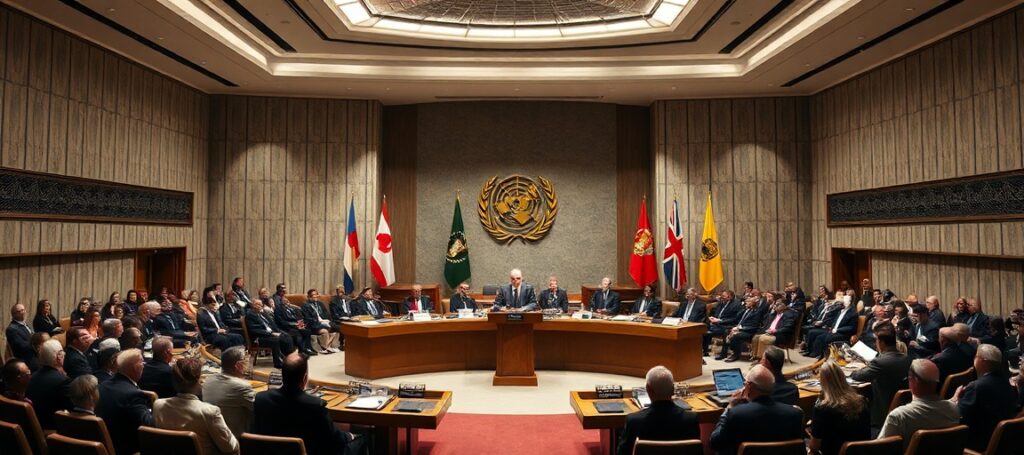
A solemn scene of a UN Security Council debate with representatives from the Conciliar Sect addressing the assembly, lacking references to Christ the King.
Antichurch

The Conciliar Sect’s UN Speech: Moralizing War While Ignoring the Kingship of Christ

VaticanNews portal reports on May 22, 2026, that the Delegation of the Holy See addressed the UN Security Council’s Open Debate on the “Protection of Civilians in Armed Conflict,” invoking the words of the usurper Leo XIV to call for the protection of civilians, places of worship, medical personnel, and to raise ethical concerns about artificial intelligence in warfare. The delegation emphasized international humanitarian law, religious freedom, prevention, dialogue, and peaceful resolution of conflicts, quoting Leo XIV that “Peace begins with each one of us: in the way we look at others, listen to others and speak about others.” What is presented as a profound moral statement is in reality a masterclass in naturalistic humanitarianism stripped of all supernatural Catholic doctrine — a diplomatic performance that would be perfectly at home in any Masonic lodge or secular humanist congress, revealing the complete theological bankruptcy of the conciliar sect occupying the Vatican.

Scroll to Top
Antichurch.org
Privacy Overview

This website uses cookies so that we can provide you with the best user experience possible. Cookie information is stored in your browser and performs functions such as recognising you when you return to our website and helping our team to understand which sections of the website you find most interesting and useful.