Antichurch

Antichurch

Naturalistic Easter in Sri Lanka’s Conciliar Sect

Summary of the Reported Event

The Vatican News portal reports on the reopening of the Our Lady of Velankanni Church on Puvaransanthivu Island, Sri Lanka, for a Feast Day celebration on March 14, 2026. After twenty years of humanitarian demining by The HALO Trust, the church, isolated and surrounded by landmines since the civil war, was deemed safe. Approximately 150 faithful traveled by boat to attend Mass celebrated by “Rev. Fr. Jero Selvanayagam.” The article emphasizes the emotional return of families, the restoration of livelihoods, and the theme of healing from past trauma, linking it to the upcoming Easter and the anniversary of the 2019 bombings. The priest is quoted expressing hope rooted in God’s presence, while a HALO Trust officer describes demining as enabling development. The report frames the event within a narrative of human recovery and interfaith peace, without reference to Catholic doctrine, the sacramental nature of the Church, or the social reign of Christ the King.

Antichurch

Easter Hope Without Christ the King: Nigerian Bishop’s Naturalistic Plea

Vatican News reports that Bishop Matthew Hassan Kukah of Sokoto, in an Easter interview, called on Nigerians to “awaken their consciences and resist despair” amid violence and insecurity. He stated that the Easter message is “fundamentally a message of hope,” urging Christians to “stand erect” and take “the message of peace more seriously” as the “best and only antidote to the violence.” Bishop Kukah condemned recent Palm Sunday killings and criticized authorities for failing to protect lives, warning that Nigerians risk becoming “totally dead to the sacredness of human life.” His solution centers on renewed faith in the Risen Christ and a collective embrace of peace.

This plea, while emotionally resonant, represents a profound reduction of Catholic Easter theology to mere naturalistic humanism, omitting the non-negotiable Catholic doctrine of the Social Reign of Christ the King and thereby propagating the very errors condemned by the pre-Conciliar Magisterium. Bishop Kukah’s “hope” is a hope without a King, a peace without Christ’s sovereign law, and a call to action devoid of the supernatural means necessary for true societal renewal. His analysis, rooted in the post-conciliar paradigm, is not a solution but a symptom of the apostasy that has emptied the Church of her mission to govern nations.

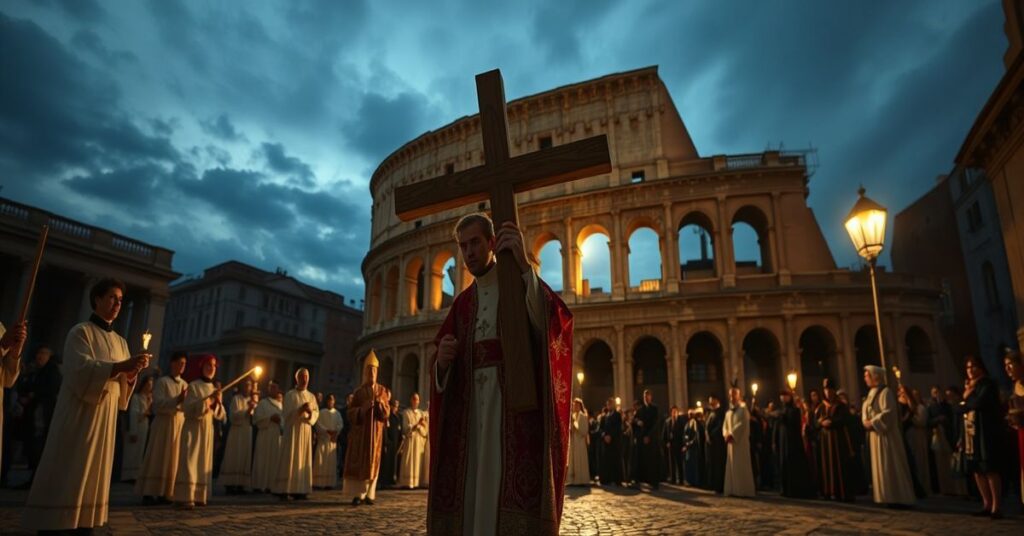
A solemn evening scene at the Colosseum in Rome where 'Pope Leo XIV' carries a cross during the Good Friday Via Crucis.
Antichurch

Antipope’s Via Crucis: Sentimentalism Masking Apostasy

The article from the National Catholic Register (April 3, 2026) reports that “Pope Leo XIV” personally carried the cross during the Good Friday Via Crucis at the Colosseum in Rome, marking the first appearance of a “Supreme Pontiff” at this event in four years. It quotes him urging the faithful to “live our lives as a journey” and to “follow in the footprints” of Christ. This performance, staged with dramatic lighting and photographic emphasis, is presented as a moment of piety and papal presence. **The event is a calculated deception, using traditional imagery to sanctify an antipope and perpetuate the conciliar sect’s substitution of naturalistic sentiment for supernatural Catholic doctrine.**

Antipope Leo XIV carries a cross in a Good Friday procession at the Colosseum, emphasizing humanistic journey over divine sacrifice.
Antichurch

Modernist “Pope” Reduces Good Friday to Naturalistic Journey

The article from the National Catholic Register, reporting on the activities of the individual occupying the Vatican as “Pope Leo XIV” on Good Friday 2026, describes a liturgical spectacle devoid of supernatural substance. The antipope personally carried the cross during the Via Crucis at the Colosseum, an event framed not as a re-presentation of the one Sacrifice of Calvary but as a symbolic “journey” focused on human authority and dignity. The meditations, authored by a Franciscan friar, emphasized that “every authority must answer before God for the manner in which it exercises the power it has received,” including temporal powers like war and human dignity, and extended this to “the power we exercise in our daily lives.” The antipope concluded by quoting St. Francis of Assisi, praying for the grace “to do for you alone what we know you want us to do and always to desire what pleases you,” and to “follow in the footprints of your beloved Son.” This presentation systematically omits the core Catholic doctrines of sin, propitiatory sacrifice, divine justice, and the absolute sovereignty of Christ the King over all nations, replacing them with a vague, humanistic spirituality of “journey” and “footprints.”

Antichurch

Modernist Distortion of the Cross: Suffering Without Penance

portal reports an excerpt from John Clark’s book *God’s Wounds*, published by Catholic Answers Press, which promotes a spirituality centered on the stigmata and the psychological “happiness” found in uniting personal suffering with Christ’s passion. The article praises modern figures like “St.” Maximilian Kolbe and “St.” Padre Pio—both products of the post-conciliar canonization machinery—as models of this “consoling” suffering. The underlying thesis is that the Cross is primarily a source of personal fulfillment and mystical union, stripped of its necessary connections to sin, judgment, the sacraments, and the Church’s penal satisfaction. This represents a profound modernist evasion, reducing the scandal of the Cross to a therapeutic narrative and silently promoting the naturalistic humanism condemned by Pius IX and Pius X.

Scroll to Top
Antichurch.org
Privacy Overview

This website uses cookies so that we can provide you with the best user experience possible. Cookie information is stored in your browser and performs functions such as recognising you when you return to our website and helping our team to understand which sections of the website you find most interesting and useful.