
May 2026

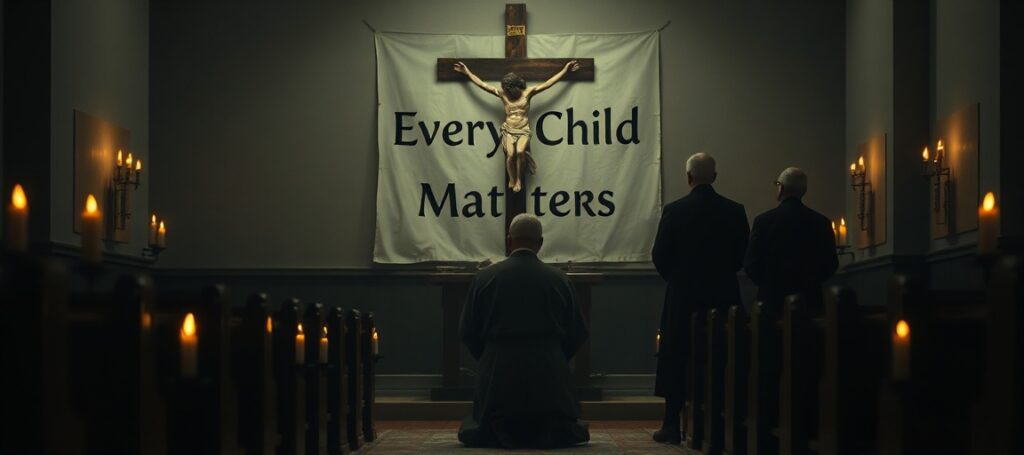
A solemn Catholic church interior with a priest praying before a crucifix, contrasting true devotion with the hollow gestures of modernist clergy.
No Category

I need to process this article from the National Catholic Register about U.S. dioceses observing Child Abuse Prevention Month, featuring statements from Cardinal Blase Cupich and Bishop Barry Knestout.

Let me analyze this thoroughly from the perspective of integral Catholic faith, following all the directives provided.

[Antichurch] Child Abuse Prevention in the Conciliar Sect: Virtue Signaling While the Abomination Continues

The National Catholic Register portal reports that U.S. dioceses of the conciliar sect are observing National Child Abuse Prevention Month, with Cardinal Blase Cupich of Chicago and Bishop Barry Knestout of Richmond issuing statements urging renewed vigilance and commitment to child protection. Cupich expressed pride in the 2002 “Charter for the Protection of Children and Young People,” while Knestout emphasized prayer, education, and recommitment to the well-being of young people.

A traditional Catholic priest in solemn attire stands outside the Pope Francis Technology School in Mongomo, Equatorial Guinea, holding a crucifix with a look of sorrow and concern.
Antichurch

Leo XIV’s Visit to a Technology School Exposes the Neo-Church’s Obsession with Worldly Progress

Vatican News portal reports that on April 22, 2026, the usurper Robert Prevost, known as “Pope” Leo XIV, visited the “Pope Francis Technology School” in Mongomo, Equatorial Guinea, during his apostolic journey to Africa. The article describes the institution as one that “works to help young people in Equatorial Guinea develop technological skills and training,” and notes that the visit occurred one day after the first anniversary of Jorge Mario Bergoglio’s death. Leo XIV is quoted as calling Bergoglio “a devoted shepherd who touched so many hearts” and praising his “courageous witness” during “a change of era.” The article further mentions that Leo XIV invited journalists aboard the papal flight to join him in thanking the Lord for “the great gift of Francis’ life to the whole Church and the world.” This entire spectacle — a visit to a technology school named after a manifest heretic, on the anniversary of his death, accompanied by effusive praise for his destruction of Catholic doctrine — is not merely a diplomatic courtesy but a revelatory window into the spiritual bankruptcy of the conciliar sect and its complete abandonment of the Church’s supernatural mission.

A Catholic priest delivering a homily in the Basilica of the Immaculate Conception in Mongomo, Equatorial Guinea, with a crucifix in the background and a projected screen displaying modernist language.
Antichurch

Self-Salvation Through Human Agency: The Anti-Gospel of Leo XIV

National Catholic Register (April 22, 2026) reports that during his apostolic journey to Equatorial Guinea, Leo XIV urged the faithful to “take the destiny of Equatorial Guinea into your own hands,” calling them to “build a future of hope, justice, and peace” through their own choices and shared commitment. The pontiff celebrated Mass at the Basilica of the Immaculate Conception in Mongomo, praised 170 years of evangelization, and encouraged the baptized to become “apostles of charity and witnesses to a new humanity.” His homily centered on naturalistic appeals to human responsibility, the common good, freedom, and human dignity — while the supernatural order, the Kingship of Christ, the necessity of the true faith for salvation, and the Church’s divine mandate to teach and govern nations were conspicuously absent. This address is not merely incomplete; it is a systematic substitution of the Catholic Gospel with the religion of man glorifying himself, precisely the error condemned by St. Pius X as the synthesis of all heresies: Modernism.

A solemn Catholic church interior with a priest preaching from the pulpit amidst an attentive congregation.
Antichurch

The Good Shepherd Without the True Shepherd: A Post-Conciliar Homily Devoid of Catholic Substance

The Pillar Catholic portal presents an episode of its “Sunday School” podcast, featuring Dr. Scott Powell and Kate Olivera discussing the readings for the Fourth Sunday of Easter, Year A — the so-called “Good Shepherd Sunday.” The episode, titled “Jesus is the Good Shepherd,” offers a preview of the liturgical readings (Acts 2:14a, 36-41; Psalm 23; 1 Peter 2:20b-25; John 10:1-10) and is sponsored by a children’s book from Our Sunday Visitor. What is presented as Catholic catechesis is, upon examination, a textbook example of the doctrinal anemia that characterizes the conciliar sect’s approach to Sacred Scripture — a reading of the Gospel stripped of its ecclesiological, sacramental, and polemical content, reduced to a warm devotional reflection suitable for a religion of sentiment rather than truth.

Spiritual

St. Joseph on Screen: A Film That Dares to Affirm Life in a Culture of Death

EWTN News reports on a new film, “Saint Joseph: Guardian of the Family,” which tells the story of a married couple facing a serious marital crisis. The husband, a journalist, is assigned to investigate testimonies of people who claim to have experienced the intercession of St. Joseph. Through this investigation, he is personally impacted by the saint and is inspired to become the guardian of his own family, striving to fix the struggles they face. The film, made by the Polish production studio Rafael Film through crowdfunding, will be released in theaters across the United States on April 23. Director Dariusz Regucki shared that the film was inspired by Father Jacek Płota, custodian of the National Shrine of St. Joseph in Kalisz, Poland. Regucki described St. Joseph as a “silent yet obedient man” who “simply does his work” and stated that the saint inspires him as a father and husband, confronting him with “the truth” and showing him “what true love really is.” The director hopes viewers will leave the cinema “moved and full of hope,” holding the hand of their spouse, and that they will “look upward, stop dwelling on their sadness and suffering, and begin to affirm life.” While the film’s intentions appear superficially pious, a rigorous examination through the lens of integral Catholic theology reveals a troubling reliance on emotionalism, a near-total silence on the indispensable sacramental and doctrinal framework of marriage, and a naturalistic anthropology that substitutes psychological comfort for the supernatural life of grace — all hallmarks of the post-conciliar spiritual malaise.

Antichurch

Vatican Automates Arizona Telescope for Jesuit Students: A Symptomatic Glimpse into the Conciliar Sect’s Naturalistic Obsession

EWTN News reports that the Vatican Advanced Technology Telescope (VATT) in Arizona has been automated for remote use by Jesuit university students, funded by donations from the Thomas Lord Charitable Trust and Kim Bepler. The article celebrates this as a step forward for scientific research and collaboration between the Vatican Observatory and Jesuit institutions worldwide. While the article presents this as a benign scientific advancement, a deeper analysis reveals it as yet another manifestation of the post-conciliar sect’s obsession with naturalistic pursuits, its subservience to secular scientific paradigms, and its systematic neglect of the supernatural mission of the Church. This automation project, far from being a neutral scientific endeavor, is symptomatic of the conciliar revolution’s shift from the supernatural to the natural, from the salvation of souls to the advancement of human knowledge, and from the reign of Christ the King to the reign of secular progress.

Antichurch

Leo XIV in Mongomo: A “Mass” Without the Cross, a “Gospel” Without Repentance

VaticanNews portal reports on April 22, 2026, that the usurper Robert Prevost, styling himself “Pope Leo XIV,” presided over a liturgical abomination at the Basilica of the Immaculate Conception in Mongomo, Equatorial Guinea, during his so-called “apostolic journey.” In his homily, the antipope urged the faithful to “proclaim the Gospel” and build a future of “hope and reconciliation” in a land rich in natural resources, while carefully avoiding any mention of sin, repentance, the necessity of baptism, or the exclusive salvific mission of the Catholic Church. This performance is a textbook example of the conciliar sect’s reduction of the Faith to naturalistic humanitarianism, masquerading as the Most Holy Sacrifice.

Antichurch

The Appointment of Rudelli: Inside the Neo-Church’s Power Consolidation

National Catholic Register portal reports on April 22, 2026, about the appointment of Archbishop Paolo Rudelli as the new “sostituto” (deputy) to the Secretary of State in the Vatican’s Secretariat of State, describing his role as crucial for the organizational machinery of the entire Vatican apparatus. The article highlights Rudelli’s diplomatic background, his youth (56 years old), and his perceived ability to harmonize the “old” and “new” Secretariat of State under the ongoing Curia reform initiated by the previous antipope. This appointment is yet another step in the consolidation of power within the conciliar sect, demonstrating the continuity of modernist governance and the entrenchment of bureaucratic structures that serve the agenda of the Antichurch.

Antichurch

The Neo-Church’s Humanist Gospel: Leo XIV Reduces the Faith to Social Activism in Equatorial Guinea

EWTN News reports that on April 22, 2026, the usurper Robert Prevost — styling himself “Pope Leo XIV” — celebrated a “Mass” at the Basilica of the Immaculate Conception in Mongomo, Equatorial Guinea, during his apostolic journey through Africa. In his homily, he urged Catholics to “take the destiny of Equatorial Guinea into their own hands,” calling them to build “a future of hope, justice, and peace,” to become “apostles of charity and witnesses to a new humanity,” and to work for “the common good rather than private interests.” He praised 170 years of evangelization, thanked missionaries and catechists, and spoke of the Eucharist as containing “every spiritual good of the Church.” Yet beneath the veneer of pious language lies a thoroughly modernist, naturalistic, and anthropocentric message — one that reduces the supernatural mission of the Church to a program of social development, strips the faith of its dogmatic content, and places man, not God, at the center of salvation history.

Scroll to Top
Antichurch.org
Privacy Overview

This website uses cookies so that we can provide you with the best user experience possible. Cookie information is stored in your browser and performs functions such as recognising you when you return to our website and helping our team to understand which sections of the website you find most interesting and useful.