Author name: amdg

Spiritual

A Brazilian Nun in Roccaporena: Between Authentic Devotion and the Ambiguities of Post-Conciliar Mission

VaticanNews portal reports on Sister Maria Atília Collet, a Brazilian member of the International Consolata Family, who at 81 years of age welcomes pilgrims in Roccaporena, Italy—the birthplace of Saint Rita of Cascia (1381-1457). The article, written by Andressa Collet, a relative of the nun, describes the sister’s daily life of prayer, her work of evangelization in Brazil, Italy, Portugal, Spain, and Mozambique, and her devotion to Saint Rita, the “Saint of Impossible Causes.” While the article presents elements of genuine Catholic spirituality—prayer, forgiveness, sacrifice, and missionary zeal—it simultaneously operates within the framework of the post-conciliar Church, raising questions about the theological integrity of the structures to which this nun belongs and the spiritual fruits of a mission conducted under the authority of antipopes and modernist hierarchs.


Antichurch

Magnifica Humanitas: The Antipope’s Silicon Gospel and the Abdication of Supernatural Education

On May 26, 2026, in the New Synod Hall at the Vatican, the antipope Leo XIV (Robert Prevost) presented his first encyclical, Magnifica Humanitas, a document devoted substantially to the impact of digital technologies and artificial intelligence on education and family life. The National Catholic Register reports that the pontiff acknowledges how “rapid technological transformations reveal just how unprepared we are on the educational level,” warning that “the pervasiveness of digital media fosters a culture of immediacy and hyper-stimulation, which gives rise to fatigue, boredom, and apathy concerning the effort required for seeking the truth.” He calls for educating people “to decide when and for what purpose it ought not to be used,” and invokes Plato’s Seventh Letter to argue that “the speed and ease with which answers or summaries can be obtained risk extinguishing the desire to ask questions.” The document further warns of “early and unsupervised exposure to digital devices,” easy access to “violent or degrading content,” “pornographic and hypersexualized material,” and pressures on young people to share intimate images. Leo XIV calls for “an alliance among policymakers, educational institutions, and families,” praises legislative initiatives in Australia, France, and Spain, and urges that schools “offer that which the digital sphere by itself cannot provide, namely a shared time for learning and developing trustworthy relationships.”

Antichurch

Magnifica Humanitas: A Manifesto of Anthropocentric Humanism Dressed in Sacred Vestments

National Catholic Register (May 25, 2026) reports that Robert Prevost, the usurper occupying Peter’s throne under the name “Pope Leo XIV,” has issued his first encyclical titled *Magnifica Humanitas*. The document addresses artificial intelligence, human dignity, children’s mobile devices, autonomous weapons, and the mystery of the human soul. EWTN News Staff describes it as “perhaps the most important Church document of our lifetime.” This characterization alone reveals the abyss of theological ignorance into which the conciliar sect has fallen — a document devoid of any substantive treatment of the supernatural order, the reality of sin, the necessity of sanctifying grace, the divinity of Christ, or the salvation of souls is hailed as the most important Church document of our era. The encyclical represents the culmination of the post-conciliar revolution: the complete reduction of the Church’s mission to a program of humanitarian sentimentalism, technological ethics, and naturalistic humanism, all while the faithful are abandoned to apostasy and the gates of Hell advance unchallenged.

Antichurch

Leo XIV’s Magnifica Humanitas: Digital Humanism Without God

EWTN News portal (May 25, 2026) reports on the first encyclical of the usurper Robert Prevost, known as “Pope” Leo XIV, titled *Magnifica Humanitas*, which addresses the impact of artificial intelligence on education and family life. The “pontiff” warns about the dangers of digital technology for youth, calls for restraint in AI use, and advocates for an educational alliance among families, schools, and public institutions. However, this entire document is a masterpiece of modernist naturalism, utterly devoid of the supernatural, reducing the Catholic faith to a vague humanistic framework where the reign of Christ the King is conspicuously absent and the salvific mission of the Church is replaced by secular pedagogy.

Antichurch

The Neo-Church Embraces the Silicon Valley Idol: A Critical Analysis of the “Encyclical” Magnifica Humanitas

The Pillar portal reports that on May 25, 2026, the usurper Robert Prevost, known as “Pope Leo XIV,” presented his first encyclical, Magnifica humanitas, dedicated to artificial intelligence. The document, touted as a programmatic text on social issues, calls for the “disarmament” of AI, criticizes autonomous weapons systems, and expresses concern for the “digital transformation’s” impact on the poor and human labor. In an unprecedented move, Leo XIV personally presented the encyclical to the curia, diplomatic corps, and press, alongside Christopher Olah, co-founder of the AI company Anthropic. The text and the accompanying event reveal a “Church” that has entirely abandoned its supernatural mission to become a chaplain for the technocratic world order, seeking relevance by dialoguing with the architects of a system that threatens to reduce the human person to data and productivity.

A traditional Catholic setting depicting a usurper on a modernist throne surrounded by symbols of humanism and technology, emphasizing the loss of true Catholic doctrine.
Antichurch

Magnifica Humanitas: The Antipope’s Manifesto of Anthropocentric Humanism

EWTN News portal reports that the current usurper of Peter’s throne, Leo XIV (Robert Prevost), has released his first encyclical titled *Magnifica Humanitas*. The article presents this document as potentially “the most important Church document of our lifetime,” covering topics such as artificial intelligence, human dignity, children’s phone usage, autonomous weapons, and the mystery of the human soul. The piece provides 15 selected quotes from the encyclical, emphasizing themes of human dignity, solidarity, technological ethics, and the irreplaceability of the human person. However, what the article praises as profound wisdom is, upon examination through the lens of integral Catholic doctrine, nothing less than a compendium of modernist errors, naturalistic humanism, and the systematic substitution of God-centered theology with anthropocentric philosophy — the very antithesis of the Church’s mission.

A traditional Catholic priest in a gothic chapel with a missal marked 'Logos', contrasting with a blurred figure of 'Pope Leo XIV' holding an AI tablet.
Antichurch

Surrendering the Logos: The Neo-Church’s Embrace of the AI Abomination

The National Catholic Register portal reports (May 25, 2026) that Dr. Jacob Goodwin, a neurologist, penned a commentary titled “The Little Mermaid’s Wager: When AI Speaks for Us,” which explicitly references and lauds a document from the usurper Robert Prevost, whom the conciliar sect addresses as “Pope Leo XIV.” The commentary discusses the implications of artificial intelligence on human writing and thought, framing it through the lens of this “papal” encyclical, *Magnifica Humanitas*. The article concludes by endorsing the “pope’s” call to “remain profoundly human” in the age of AI, presenting this stance as a balanced Catholic response to technological advancement. This entire narrative, however, is a masterclass in modernist diversion, focusing on a peripheral technological distraction while the very pillars of the Faith are being systematically dismantled by the very “authorities” it dares to quote.

A Catholic prisoner in a dimly lit cell holding a rosary, symbolizing hope and repentance with a subtle glow from the beads and a faint vision of the Virgin Mary in the background.
Spiritual

Hope as the Antidote to Pride: A Catholic Reflection on the Humblest Theological Virtue

The National Register portal (May 25, 2026) published a commentary by Joseph Pearce under the title “Mary, Mother of the Church: Hope Is the Sweetness of Our Life.” The article presents hope as the humblest of the theological virtues, yet the one that slays pride—the greatest of sins—comparing hope to David and pride to Goliath. Pearce draws upon the pagan myth of Pandora’s Box as an allegory for humanity’s fallen state, in which hope alone remains. He then recounts his personal testimony: as a young man imprisoned for involvement in a white supremacist organization, he discovered hope through a rosary sent to him, which eventually led him into the Catholic Church. The article concludes with an exhortation to turn to Mary as “our life, our sweetness, and our hope.” While the piece contains elements of genuine Catholic teaching on the theological virtues and the intercession of the Blessed Virgin, it is marred by a troubling naturalism, an uncritical embrace of pagan mythology as a vehicle of truth, and a personal narrative that, while moving, is presented within a framework that omits the supernatural economy of grace, the necessity of the sacraments, and the authority of the true Church as the sole ark of salvation.

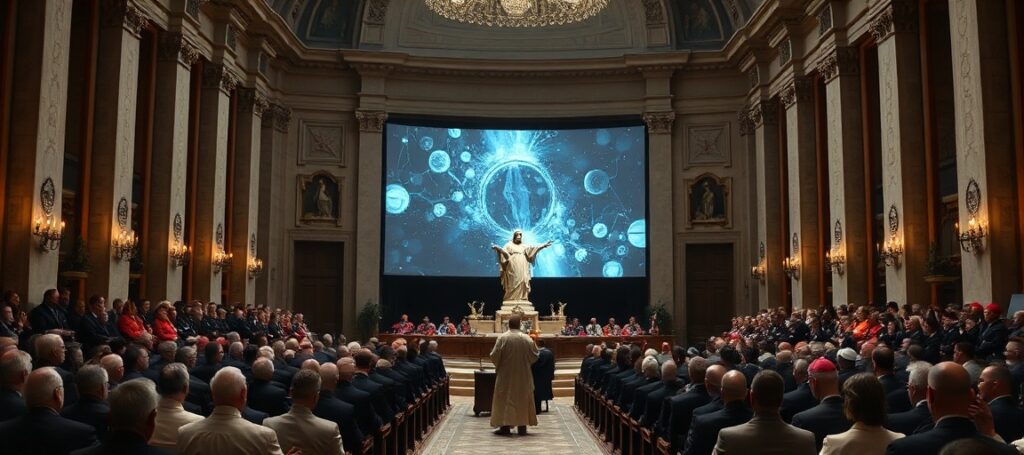
A solemn presentation of an AI-themed encyclical in the Vatican's Synod Hall, featuring modernist clerics and technologists, symbolizing the spiritual decay of the Neo-Church.
Antichurch

The Neo-Church Embraces the AI Idol: Magnifica Humanitas and the Abandonment of Supernatural Truth

National Catholic Register reports on the presentation of the first encyclical of the self-styled Leo XIV, “Magnifica Humanitas,” on artificial intelligence. The event, held in the Vatican’s Synod Hall, featured Christopher Olah, co-founder of the AI company Anthropic, who praised the document and called for dialogue between the “Church” and the tech industry. Leo XIV compared the impact of AI to the Industrial Revolution and called for AI to be “disarmed,” emphasizing the need for moral discernment and public control. He claimed the encyclical was born from listening to various voices, including scientists, engineers, and those concerned about autonomous weapons and biased algorithms. The event also included speeches by Cardinals Parolin, Fernández, and Czerny, as well as theologians Anna Rowlands and Leocadie Lushombo. This spectacle reveals the utter bankruptcy of the post-conciliar structure, which, having abandoned the supernatural mission of the Church, now seeks relevance by baptizing the latest technological idolatry and positioning itself as a mere “moral voice” among many in the globalist project.

Scroll to Top
Antichurch.org
Privacy Overview

This website uses cookies so that we can provide you with the best user experience possible. Cookie information is stored in your browser and performs functions such as recognising you when you return to our website and helping our team to understand which sections of the website you find most interesting and useful.