
Author name: amdg

A somber image depicting the antipope Robert Prevost and tech executive Christopher Olah in a dimly lit Synod Hall, surrounded by cardinals and theologians, emphasizing the abandonment of Christ the King and the spiritual bankruptcy of the conciliar sect.
Antichurch

Magnifica Humanitas: The Antipope’s Technological Idolatry and the Abandonment of Christ the King

EWTN News portal reports on May 25, 2026, that Robert Prevost, known as “Pope Leo XIV,” unveiled his first encyclical, *Magnifica Humanitas*, in a ceremony at the Vatican’s Synod Hall. The event was attended by members of the Roman Curia, academics, diplomats, and notably Christopher Olah, co-founder of Anthropic, a major artificial intelligence company. The self-styled pontiff praised the inclusion of a non-believing tech executive as a “sign of hope” and emphasized the need for “dialogue” and “mutual effort” to address the challenges of AI. He compared the current technological transformation to the Industrial Revolution, suggesting it may have “even greater consequences.” The document, signed on May 15, the anniversary of Leo XIII’s *Rerum Novarum*, calls for AI to be “disarmed” and warns of its impact on warfare, healthcare, and employment. The event featured speeches by Cardinals Parolin, Fernández, and Czerny, as well as theologians Anna Rowlands and Leocadie Lushombo. This entire spectacle is a grotesque parody of Catholic teaching, replacing the supernatural order with a fetishization of technology and a desperate plea for relevance in a world hurtling towards the abyss.
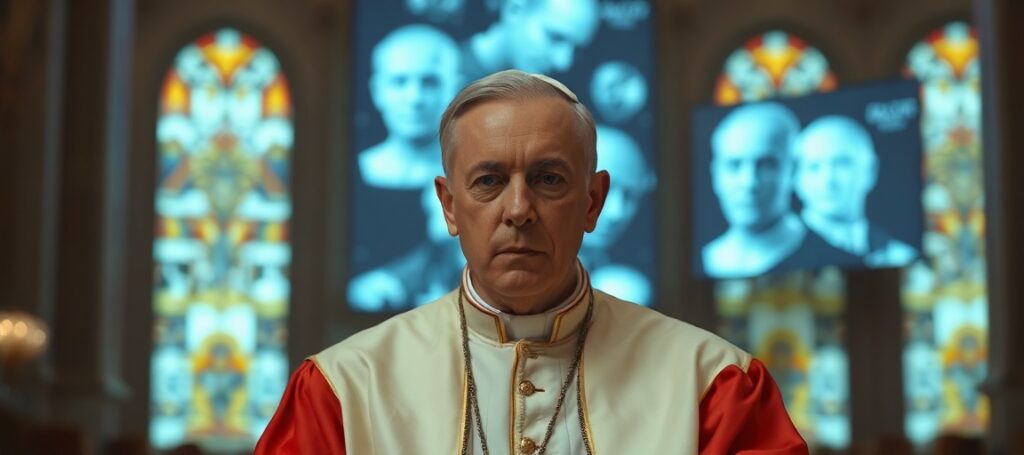

Antipope Leo XIV in papal vestments in a modernist Vatican hall with AI-themed imagery, symbolizing the modernist reduction of Catholic teaching to naturalistic humanism.
Antichurch

Magnifica Humanitas: A Manifesto of Naturalistic Humanism Dressed in Papal Vestments

The Pillar Catholic portal reports on the release of “Magnifica humanitas,” the first encyclical of the antipope Leo XIV (Robert Prevost), dated May 25, 2026. The document, subtitled “On the safeguarding of the human person in the time of artificial intelligence,” purports to apply Catholic social teaching to the challenges posed by artificial intelligence in education, politics, work, and war. It critiques transhumanism and posthumanism while calling for the defense of human dignity and acknowledging the Church’s historical slowness in condemning slavery. However, a thorough examination reveals that this encyclical is not a defense of the integral Catholic faith, but rather a sophisticated articulation of modernist principles, reducing the Church’s mission to naturalistic humanism and further entrenching the conciliar sect’s departure from immutable Tradition.

Cardinals kneeling before indigenous campesinos in a 'Mass of Reparation' in Catacaos, Peru, symbolizing the conciliar sect's inversion of divine hierarchy and sacramental order.
Antichurch

Kneeling Before the World: The Conciliar Church’s Theater of Repentance

VaticanNews portal reports on a “Mass of Reparation” held on May 23, 2026, in Catacaos, Peru, where Vatican delegates—including Cardinals Carlos Castillo Mattasoglio and Pedro Barreto—and Peruvian bishops knelt before indigenous campesinos to ask forgiveness for abuses committed by members of the dissolved “Sodalitium Christianae Vitae.” The article frames this gesture as a culmination of reconciliation efforts initiated by Pope Francis and continued by Pope Leo XIV, emphasizing themes of renewal, hope, and peace. Yet beneath the veneer of humility lies a profound theological inversion: the conciliar sect, having long abandoned its divine mandate to teach and govern, now performs public penance before the very world it was once ordained to consecrate to Christ the King.

A Catholic priest in traditional vestments holds Leo XIV's Magnifica Humanitas encyclical, contrasting with fading secular figures in a dim Vatican hall.
Antichurch

The Encyclical of Humanism: Leo XIV’s Magnifica Humanitas and the Erasure of Christ the King

National Catholic Register portal reports on May 25, 2026, that the first encyclical of the antipope Leo XIV, titled Magnifica Humanitas, draws upon a vast array of secular and non-Catholic sources — from Viktor Frankl and Hannah Arendt to J.R.R. Tolkien, Beethoven, Picasso, Steven Spielberg, Martin Luther King Jr., Marie Curie, Maria Montessori, Wangari Maathai, Benazir Bhutto, and even Plato — while conspicuously marginalizing the unchanging sources of Catholic doctrine: the Church Fathers, the ecumenical councils, and the perennial Magisterium. The article presents this syncretic compilation as evidence of a “broad range of cultural and philosophical figures for inspiration,” thereby revealing the conciliar sect’s complete capitulation to the cult of man and the abolition of the supernatural order.

Antichurch

Magnifica Humanitas: A Manifesto of Modernist Apostasy Dressed as an Encyclical

EWTN News portal reports on the first encyclical of the usurper Robert Prevost, “Leo XIV,” titled *Magnifica Humanitas*, in which he draws inspiration not from the Church Fathers, Doctors, or saints of the true Catholic tradition, but from a pantheon of secular humanists, heretics, and figures of dubious faith — including J.R.R. Tolkien, Beethoven, Martin Luther King Jr., Hannah Arendt, Viktor Frankl, and even the condemned “Saint” Faustyna Kowalska. This encyclical is not a magisterial document of the Catholic Church but a manifesto of the conciliar sect’s apostate ideology, replacing divine revelation with naturalistic humanism and the cult of man.

Antichurch

Leo XIV’s “Magnifica Humanitas”: A Masonic Manifesto for the Digital Antichrist

Vatican News portal (May 25, 2026) reports on the promulgation of the encyclical “Magnifica Humanitas” by the usurper Leo XIV (Robert Prevost), presenting it as the conciliar sect’s response to artificial intelligence, calling for AI “disarmament” and placing technology at the service of “human dignity, solidarity and the common good.” The document draws explicit parallels with Rerum Novarum and invokes the usual modernist buzzwords: dialogue, cooperation, human fraternity, and a “civilisation of love.” Stripped of its pious veneer, this encyclical represents yet another capitulation of the occupying Vatican structures to the globalist agenda, reducing the Church’s supernatural mission to a humanitarian NGO advocating for technological ethics while remaining silent on the only true solution: the Social Kingship of Christ and the integral reign of God’s law over all creation.

Antichurch

Leo XIV’s Demographic Springtide: A Modernist Blueprint for Europe’s Spiritual Winter

Vatican News reports that on May 25, 2026, the usurper Robert Prevost, known as “Pope” Leo XIV, addressed members of the European Parliament’s Intergroup on Demography, urging European leaders to confront the continent’s demographic crisis through renewed support for families, intergenerational solidarity, and human dignity. He warned that Europe risks becoming “the ‘old continent'” due to its ageing population, described declining birth rates as a “time of drastic sterility,” criticized policies promoting abortion as a right, and called for a “fresh springtide for the family” to transform the “winter chill of our ageing populations.” While seemingly echoing traditional Catholic concerns about family and life, this address reveals the same fundamental apostasy that has characterized the conciliar sect since 1958: the reduction of the Church’s supernatural mission to naturalistic humanism, the embrace of secular institutions as partners in salvation, and the systematic omission of the only true remedy for Europe’s crisis—the return to the Social Reign of Christ the King and the integral Catholic faith that built Christian civilization.

Antichurch

Magnifica Humanitas: The Anti-Human Vision of a Usurper Enthroning Man as God

The National Catholic Register reports that on May 25, 2026, the usurper Robert Prevost, styling himself “Pope Leo XIV,” released his first encyclical letter titled *Magnifica Humanitas: On Safeguarding the Human Person in the Time of Artificial Intelligence*. The document calls for “shared standards of social justice” in AI development, warns against a “technocratic paradigm,” and proposes Catholic Social Doctrine as a framework for evaluating technology. It addresses education, economy, work, human trafficking, and war, while invoking St. Augustine, St. John Paul II, and other figures. The encyclical frames the choice between technology as a tool for human flourishing or domination as a spiritual battle between building “Babel” or “Jerusalem.” Yet beneath its lofty language lies a profound betrayal of the Faith — a naturalistic, modernist manifesto that reduces the supernatural mission of the Church to secular humanitarianism, ignores the primacy of the salvation of souls, and perpetuates the very errors condemned by the true Popes.

Scroll to Top
Antichurch.org
Privacy Overview

This website uses cookies so that we can provide you with the best user experience possible. Cookie information is stored in your browser and performs functions such as recognising you when you return to our website and helping our team to understand which sections of the website you find most interesting and useful.