
Author name: amdg

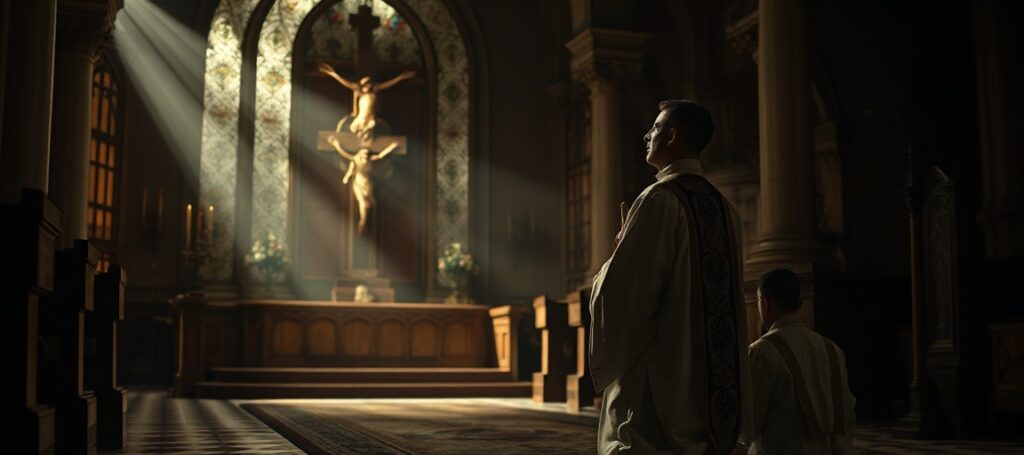
A Catholic priest in traditional vestments kneeling in prayer before a crucifix in a dimly lit church, symbolizing the spiritual battle against modern apostasy and the call for true penance.
World

Abstaining From Digital Noise While Ignoring the Real Spiritual Battle

The National Catholic Register, in its editorial of April 30, 2026, proposes a “fast from social media” as a remedy for the escalating political violence in the United States, citing the recent assassination attempt on President Trump and the murder of Charlie Kirk. The editorial draws a parallel to President Lincoln’s 1863 national day of fasting during the Civil War, suggesting that a “digital detox” could help restore national unity and peace. It references Bishop Robert Barron’s condemnation of online “viciousness and tribalism” and even cites a study showing improved attention spans and reduced depression after just two weeks of blocking internet access. While the superficial logic of reducing online toxicity might seem appealing, this proposal is a profound spiritual evasion, a classic modernist diversion that addresses symptoms while ignoring the root cause of societal collapse: the rejection of Christ the King and the pervasive apostasy within the structures occupying the Vatican.
Antichurch

Virtual Academy of the Conciliar Sect: Digital Expansion of a Structure in Apostasy

The article from EWTN News (April 30, 2026) reports that the Archdiocese of Atlanta, a territorial jurisdiction of the post-conciliar conciliar sect occupying the structures of the Catholic Church, is launching a fully online high school program called “Sacred Heart Virtual Academy.” The program, designed for grades 9–12 both within and outside the archdiocese, including internationally, is presented as an expansion of “Catholic education” to home-schooling families, rural students, and those with “diverse learning needs.” Kim Shields, described as facilitator and associate superintendent, stated the program aims to have an “impact on a global scale” and that the archdiocese will “welcome anyone who feels our program will meet their child’s learning needs.” The article quotes the Office of Catholic Schools’ commitment to education “in accordance with the teachings of the Catholic Church” and the belief that “all of God’s children deserve a Catholic education.” This initiative, dressed in the language of accessibility and mission, is in reality another manifestation of the conciliar sect’s systematic effort to extend its apostate structures globally through digital means, all while remaining entirely silent about the one thing necessary: the state of the soul, the necessity of true sacraments, and the obligation to profess the integral Catholic faith without compromise.

Antichurch

Ecumenical Prayer in Dubai Exposes the Apostasy of the Conciliar Sect

VaticanNews portal reports on April 30, 2026, that Christian leaders gathered at St. Mary’s Church in Dubai for a “National Ecumenical Prayer for Peace,” an event promoted by the Gulf Churches Fellowship in collaboration with the Interfaith & Ecumenical Dialogue Office of the Apostolic Vicariate of Southern Arabia (AVOSA). Bishop Paolo Martinelli, the Apostolic Vicar, stated that “peace cannot be simply a human construct; it is a gift from God,” and thanked civil authorities for their protection. The event included representatives from six Christian denominations—including schismatic and heretical bodies such as the Armenian, Ethiopian Orthodox, Anglican, Greek Orthodox, and Coptic churches—who jointly professed the Nicene Creed, read Scripture, and exchanged a “sign of peace.” This spectacle of false ecumenism, where the one true Catholic Faith is reduced to mere “good relationships” and interreligious diplomacy, is not a gesture of Christian charity but a public denial of the Church’s exclusive claim to be the sole ark of salvation, in direct violation of centuries of immutable Catholic doctrine.

Antichurch

Pope Leo XIV’s “Charity” Without Truth: The Post-Conciliar Subversion of the Church’s Mission

Vatican News portal reports (April 30, 2026) that the usurper Robert Prevost, calling himself “Pope Leo XIV,” met with a delegation from the Archdiocese of Cologne to celebrate the 50th anniversary of its “Diocesan Office for the Universal Church and Dialogue.” In his address, he praised the Archdiocese’s “prophetic openness” to the Church’s universal dimension, emphasizing “dialogue,” “solidarity,” and “bearing witness to the truth in charity.” He also recalled his time as Bishop of Peru, highlighting aid initiatives like purchasing oxygen-producing machines. The article presents these activities as exemplary expressions of the Church’s mission.

Antichurch

Easter Vigil Numbers Expose the Conciliar Sect’s Ignorance of Its Own Converts

At Easter vigil, adults stepped into baptismal waters in parishes all across the United States. The Church welcomed them, and by Monday morning everyone was talking about the numbers. Hallow found a 38% average year-over-year increase in OCIA initiations across more than 140 dioceses. Los Angeles welcomed 8,500 new Catholics. Newark rose 72% since 2023. The New York Times and other secular outlets ran features.

The article from the Pillar Catholic portal reports on the notable increase in OCIA (Order of Christian Initiation of Adults) initiations across the United States during the Easter Vigil, with a 38% average year-over-year increase across more than 140 dioceses, Los Angeles welcoming 8,500 new Catholics, and Newark rising 72% since 2023. The author, Jose Manuel De Urquidi, notes that the last major American study of OCIA motivations was a USCCB survey from 2000, when 88% entered for marriage or family reasons and only 12% for a personal spiritual quest, and that France is now conducting research into conversion motivations while the United States lacks such data. The article raises questions about whether these converts are driven by trend-following or a genuine need for the sacraments, and what role the digital world played in these conversions. The entire discussion proceeds within the framework of the conciliar sect, treating its sacramental rites as valid and its institutional structures as legitimate, while the fundamental question of whether any of these “initiations” produce true supernatural grace is never even considered.

Antichurch

“Peace” Without Christ the King: Cardinal Cupich’s Modernist Abstraction

Vatican News portal reports that Cardinal Blase J. Cupich of Chicago, upon receiving the Catholic Theological Union’s “Blessed are the Peacemakers” award, delivered a speech on April 30, 2026, in which he dismissed just war theory as “the wrong starting point,” warned against the “gamification” of war through screens, and called for a “culture of peace” grounded not in doctrine but in “human suffering” and abstract Gospel demands. The cardinal quoted Leo XIV’s Palm Sunday homily rejecting the prayers of “those who wage war,” and framed peacebuilding in terms of serenity, creativity, sensitivity, and skill drawn from the modernist exhortation Gaudete et Exsultate. What is conspicuously absent from this entire discourse — and what renders it spiritually bankrupt — is any mention of Jesus Christ as King of nations, the obligation of states to submit to His reign, the reality of sin as the root cause of war, the necessity of the Most Holy Sacrifice for true peace, or the Church’s divinely ordained authority to teach, govern, and judge both rulers and the ruled.

Antichurch

Ecclesiastical Communion Granted to Chaldean Patriarch: A Study in Post-Conciliar Ecclesial Apostasy

The National Catholic Register reports that on April 24, 2026, the individual occupying the Vatican, Robert Prevost (referred to in the article as “Pope Leo XIV”), granted “ecclesiastical communion” to Mar Paul III Nona, the newly elected patriarch of the Chaldean Catholic Church. The article explains that this act is a “formal recognition of full communion with the Diocese of Rome,” enabling the patriarch to exercise his ministry fully. The source describes this as a standard procedure for autonomous Eastern Catholic Churches under the authority of the Roman usurper, citing Canon 27 of the Code of Canons of the Eastern Churches and Canon 76 § 2. The article further notes the patriarch’s succession of Cardinal Louis Raphael Sako and the encouragement of the faithful to persevere as “true believers” amidst trials. This report, while presented as routine ecclesiastical administration, reveals a profound theological and ecclesiological bankruptcy inherent in the post-conciliar structures, a bankruptcy that can only be fully exposed by the immutable light of pre-1958 Catholic doctrine.

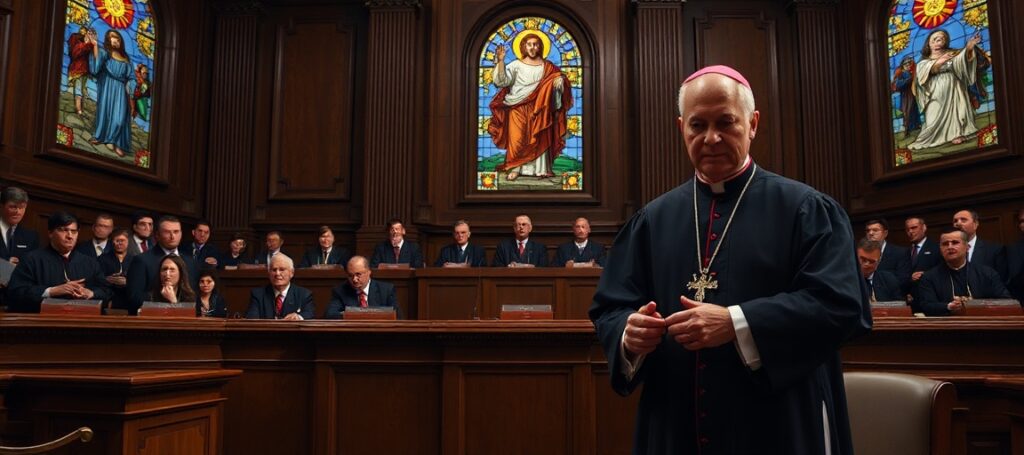
Supreme Court justices deliberating on migrant status with a Catholic bishop praying in the foreground, symbolizing divine law over secular power.
World

When State Power Replaces Divine Law: The Supreme Court and the Migrant Crisis

The National Catholic Register portal reports that on April 29, 2026, the U.S. Supreme Court heard oral arguments concerning the Trump administration’s efforts to terminate Temporary Protected Status (TPS) for over 350,000 Haitian and 6,000 Syrian migrants. The debate centered on executive discretion, procedural adherence, and allegations of racial animus, with the United States Conference of Catholic Bishops (USCCB) urging an extension of the status. While the article presents a legal and political skirmish, it entirely omits the supernatural perspective of the Church, reducing a profound moral question to a mere administrative “box-checking exercise” and ignoring the absolute primacy of God’s Laws over the shifting sands of secular governance.

A traditional Catholic chapel at the University of St. Thomas in Houston contrasts with modern university buildings, symbolizing the conciliar illusion of Catholic identity without true faith.
Antichurch

Catholic Revival or Conciliar Illusion? The University of St. Thomas Board Appointments

National Catholic Register portal reports that the University of St. Thomas (UST) in Houston has appointed several prominent Catholic figures to its board of directors, including R.R. “Rusty” Reno, editor of First Things; Adam Laxalt, former attorney general of Nevada; and Mary Eberstadt, writer and senior research fellow at the Faith and Reason Institute. The appointments are framed as part of the university’s “confident renewal of its Catholic identity,” with board members expressing enthusiasm for what they describe as an orthodox Catholic revival among American youth. The article presents these developments as a hopeful sign of Catholic renewal in higher education, quoting the new board members about their vision for the institution and the broader cultural moment.

Yet beneath this veneer of optimism lies a profound theological void that reveals the bankruptcy of the conciliar project’s approach to Catholic education and formation.

A Catholic priest in traditional cassock stands before a cathedral holding a bankruptcy petition, symbolizing the institutional collapse of the modernist conciliar sect as secular authorities intervene.
Antichurch

Bankruptcy Bill Exposes the Rot Within the Conciliar Sect’s Institutional Collapse

The National Catholic Register reports on a proposed federal bill, the “Closing Bankruptcy Loopholes for Child Predators Act,” introduced by Rep. Deborah Ross (D-NC) and Rep. Emilia Sykes (D-OH), which would allow child abuse victims to continue seeking evidence in civil suits even during Chapter 11 bankruptcy proceedings. The bill targets organizations, including U.S. Catholic dioceses, that have allegedly used bankruptcy filings to shield themselves from discovery processes and accountability. The article notes that numerous U.S. dioceses have filed for bankruptcy in recent years, particularly in response to state-level laws expanding statutes of limitations for child abuse claims. While the article presents bankruptcy as generally advantageous for victims, ensuring broader compensation, the proposed legislation aims to close perceived “loopholes” that limit victims’ ability to seek evidence and transparency during bankruptcy proceedings.

Scroll to Top
Antichurch.org
Privacy Overview

This website uses cookies so that we can provide you with the best user experience possible. Cookie information is stored in your browser and performs functions such as recognising you when you return to our website and helping our team to understand which sections of the website you find most interesting and useful.