Author name: amdg

A solemn image depicting a traditional Catholic university setting with students and faculty engaged in prayer or study, emphasizing the integral Catholic faith before 1958.
Antichurch

The University of St. Thomas Board Appointments: A Study in Post-Conciliar Catholic Identity Theater

EWTN News reports that the University of St. Thomas in Houston has appointed several prominent Catholic figures to its board of directors, including R.R. “Rusty” Reno, Adam Laxalt, and Mary Eberstadt. The article presents these appointments as part of the university’s “confident renewal of its Catholic identity,” with the new board members expressing enthusiasm for building a stronger Catholic academic institution. However, a thorough examination of the individuals involved, the language employed, and the theological omissions reveals not a genuine restoration of Catholic identity but rather a sophisticated performance of Catholic identity theater characteristic of the post-conciliar era—one that carefully avoids any confrontation with the radical apostasy that has consumed the institutional Church since Vatican II and fundamentally compromises the very notion of Catholic higher education.

A traditional Catholic priest holding Pope Leo XIII's 'Humanum Genus' in a dimly lit church sanctuary, gazing at the starry sky through a stained-glass window.
Antichurch

An Asteroid for a Pope: The Cult of Personality Reaches the Heavens

The National Catholic Register (NCRegister) portal reports that the Vatican Observatory has named an asteroid “Gioacchinopecci” in honor of Pope Leo XIII, who refounded the observatory in 1891. The article also mentions asteroids named for other figures associated with the Vatican Observatory, including cardinals and Jesuit astronomers, and briefly describes the history of the observatory’s relocation due to light pollution. The piece presents this as a celebration of the Church’s historical patronage of science. However, beneath this seemingly innocent tribute lies a profound distraction from the true state of the Church and the spiritual crisis that has consumed it since the conciliar revolution, revealing a neo-church more concerned with its public image in the natural order than with the salvation of souls.

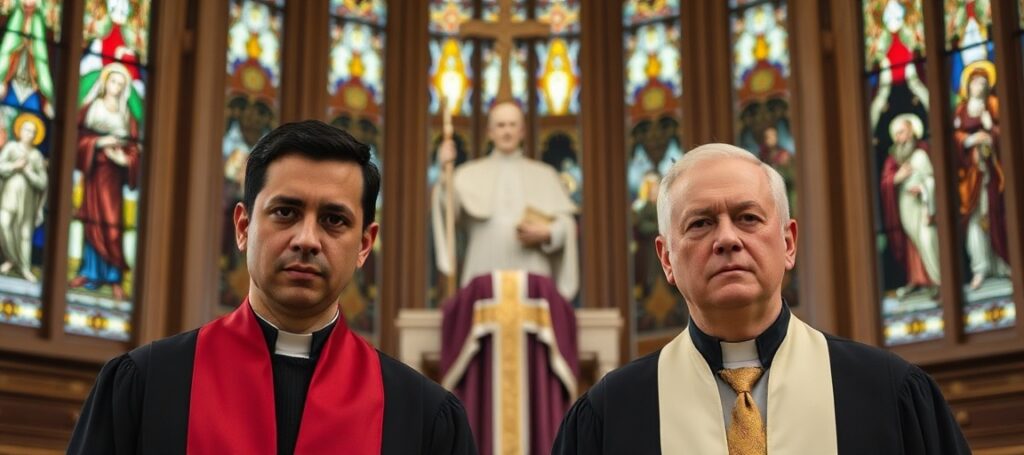
Two Catholic scientists from The Catholic University of America in a chapel with Christ the King imagery, reflecting on their role in a secularist system.
World

Trump Dismisses National Science Foundation Board: A Constitutional Correction in a Secularist Order

National Catholic Register portal reports on the dissolution of the National Science Foundation board by the Trump administration, which included two high-ranking staff members from The Catholic University of America. This action, while presented as a routine administrative measure, exposes the inherent tensions within a secularist state apparatus that claims neutrality yet operates under principles fundamentally at odds with the Social Reign of Christ the King. The dismissal of these individuals, regardless of their personal faith, highlights the ultimate subordination of all temporal affairs to the divine law, a truth the modern world consistently seeks to obscure.

A Catholic bishop in traditional vestments stands in a grand cathedral, holding a document representing a federal bill threatening Church autonomy.
Antichurch

Bankruptcy “Reform” Bill: A Secular Assault on Church Autonomy and a Symptom of Post-Conciliar Capitulation

EWTN News reports on a proposed federal bill, the “Closing Bankruptcy Loopholes for Child Predators Act,” which aims to allow child abuse victims to continue seeking evidence and submit impact statements even during Chapter 11 bankruptcy proceedings. This measure, if enacted, would directly impact U.S. Catholic dioceses facing abuse lawsuits, ostensibly to ensure “justice, accountability, and transparency” for survivors by preventing organizations from using bankruptcy as a “shield.” While the suffering of abuse victims is undeniable and demands genuine justice, this legislative effort, viewed from the perspective of integral Catholic faith, represents a profound secular encroachment upon the Church’s divinely instituted autonomy, a misapplication of temporal power to spiritual matters, and a tragic symptom of the post-conciliar Church’s weakened doctrinal stance and capitulation to worldly pressures. The true “loophole” lies not in bankruptcy law, but in the systemic failure of the conciliar structures to uphold immutable Catholic doctrine on the Church’s nature, its independence from the state, and the spiritual primacy of its mission.

Aaron Dominguez and Victor McCrary standing in a grand Catholic chapel after being dismissed from the National Science Board
World

Trump Purges Science Board as Catholic Academics Bow to Secular Power

EWTN News portal reports that U.S. President Donald Trump has dissolved the National Science Foundation’s governing board, which included two senior staff members from The Catholic University of America (CUA). Aaron Dominguez (CUA Executive Vice President and Provost) served as vice chairman of the National Science Board (NSB), while Victor McCrary (CUA Vice Provost) served as its chair before all 22 board members were fired on April 24, 2026. The White House cited constitutional questions raised by the 2021 Supreme Court case U.S. v. Arthrex, which addressed whether non-Senate confirmed appointees can exercise certain executive authorities. The NSB oversees the NSF, advises the president and Congress on science policy, approves funding awards, and publishes influential reports on U.S. science priorities. Both CUA and the affected individuals declined to comment.

St. John the Evangelist writing his Gospel under the spiritual guidance of the Blessed Virgin Mary in a traditional Catholic setting.
Spiritual

Mary’s Voice in St. John’s Gospel: A Commentary Devoid of Supernatural Depth

The National Catholic Register portal reports on a commentary by Michael Pakaluk, “Mary’s Voice in the Gospel According to John,” which proposes that the Blessed Virgin Mary’s influence is a hidden yet pervasive “oversound” throughout the Fourth Gospel, shaping its distinctive characteristics due to her thirty years of shared life with St. John. While the article presents an intriguing literary and historical premise, it ultimately reduces the profound supernatural reality of the Gospel to a mere humanistic exercise in psychological projection and sentimentalism, characteristic of the post-conciliar era’s shallow engagement with sacred texts.

A young person gazing at an AI wearable device in a traditional Catholic chapel, highlighting the spiritual conflict between technology and divine focus.
Antichurch

The Narcissus Trap: AI Wearables and the Risk of Self-Obsession

NC Register portal reports on the dangers of wearable AI devices, warning that users could become obsessed with their own data, much like Narcissus with his reflection. The article discusses various devices like the Oura Ring, Nirva pendant, and Nuna Emotion Tracking Pendant, which collect and analyze vast amounts of personal health and emotional data. It also references a message from “Pope” Leo XIV for the World Day of Social Communications, warning about the risks of AI altering human communication and identity. The article concludes by urging readers not to let technology distract them from seeking self-knowledge in relation to their Creator. While the article attempts to address a genuine spiritual danger, its analysis remains superficial, failing to root itself in the unchanging Catholic doctrine on the nature of man, the purpose of creation, and the absolute primacy of the supernatural life, instead relying on modernist frameworks and a conciliar “pontificate” for its ultimate authority.

A devout Catholic kneeling in prayer before a crucifix, with a Peter's Pence box in the foreground, set in a traditional church interior with stained-glass windows. The scene reflects sorrow and betrayal over misused donations.
Antichurch

Peter’s Pence Lawsuit Exposes the Bankruptcy of Conciliar Stewardship

National Catholic Register portal (April 29, 2026) reports on the lawsuit United States Conference of Catholic Bishops v. O’Connell, in which a Rhode Island parishioner alleges he was misled about the use of his Peter’s Pence donation, claiming funds were directed to luxury real estate and Hollywood productions rather than to the poor. The USCCB, represented by Becket, has petitioned the Supreme Court, invoking the First Amendment’s church-autonomy doctrine. Legal analyst Andrea M. Picciotti-Bayer argues that the case raises urgent constitutional questions while simultaneously urging Catholics to be “informed givers” who practice “prudent stewardship.” The article frames the dispute as both a defense of religious liberty and an internal Catholic responsibility. This framing itself reveals the profound theological confusion of the concilar era: the reduction of sacred ecclesial governance to a matter of corporate nonprofit management, and the subordination of divine law to secular legal frameworks.

Antichurch

A Modernist’s Baptismal Gratitude: Omitting the Supernatural for the Sake of a Naturalistic Communion of Saints

George Weigel, writing for the National Catholic Register, offers a personal reflection on the 75th anniversary of his baptism, focusing on the “communion of saints” as a “great cloud of witnesses” encountered through various individuals in his life. While superficially touching on Catholic themes, the article reveals a profoundly naturalistic and modernist understanding of sanctity and the Church, conspicuously omitting any mention of the supernatural means of grace, the necessity of the true Church for salvation, the reality of original sin’s remission, or the ultimate purpose of baptism – eternal life with God through the merits of Christ’s sacrifice. Instead, Weigel presents a sentimentalized, human-centric view where “sanctity” is equated with admirable human qualities or experiences, reducing the profound mystery of incorporation into Christ to a mere sociological or emotional connection with exemplary figures, many of whom are products of or aligned with the conciliar revolution.

Scroll to Top
Antichurch.org
Privacy Overview

This website uses cookies so that we can provide you with the best user experience possible. Cookie information is stored in your browser and performs functions such as recognising you when you return to our website and helping our team to understand which sections of the website you find most interesting and useful.