Spiritual

Spiritual

When the Heavens Speak, the Soul Reaches for the Cross

The National Catholic Register reports on the emotional aftermath of the Artemis II lunar mission, in which commander Reid Wiseman, describing himself as “not really a religious person,” broke down in tears upon seeing the cross on a Navy chaplain’s collar after splashdown. The article presents this as a spontaneous, authentic encounter with the divine — a moment of transcendence that supposedly validates the spiritual significance of space exploration. Yet beneath this sentimental veneer lies a profound theological void, a naturalistic reduction of the supernatural order, and a telling silence about the only true source of grace and salvation: the Holy Catholic Church and her sacraments. The article’s framing — celebrating a NASA astronaut’s emotional reaction to a chaplain’s collar while ignoring the state of his soul, the validity of his baptism, and the doctrinal content of his faith — is symptomatic of the post-conciliar Church’s capitulation to secular humanism and its replacement of supernatural religion with mere sentimentality.


A Catholic hospital room with a dying man receiving the anointing of the sick by a priest, his wife praying beside him. The scene reflects the importance of objective faith over subjective experiences.
Spiritual

When Personal Experience Replaces the Faith of the Church

National Catholic Register portal reports on the testimony of Virginia Pérez de Santana, who recounted how her husband Miguel, diagnosed with an aggressive brain tumor, claimed to have had a direct experience of God in a hospital room — an embrace, a voice, and an overwhelming sense of peace — before dying in March 2026. The article presents this private mystical experience as an edifying confirmation of the faith, complete with daily rosary, anointing of the sick, and a prayer chain of 500 people. What is presented as a beautiful story of Catholic devotion is, upon examination through the lens of integral Catholic theology, a case study in the modernist substitution of subjective religious experience for the objective truths of the Faith, and a dangerous drift toward the very errors the Church has always condemned in the matter of private revelation.

A traditional Catholic hospital room scene with a dying man receiving last rites from a priest, his wife by his side.
Spiritual

When Personal Experience Replaces the Faith: The Subtle Naturalism of Sentimental Catholic Testimony

The EWTN News portal published on April 15, 2026 an article recounting the testimony of Virginia Pérez de Santana regarding the death of her husband Miguel from brain cancer. The narrative follows a predictable pattern increasingly common in post-conciliar Catholic media: a terminally ill man has a subjective “experience with God” in a hospital room, feels warmth and an embrace, and subsequently radiates peace. His wife then universalizes this private experience as proof of God’s existence and encourages others to “lean on the testimonies of others” because “he is real.” The article, presented as edifying content, is in fact a textbook example of the modernist substitution of personal religious experience for the objective truths of the Catholic faith, the elevation of sentiment over doctrine, and the reduction of supernatural religion to psychological comfort.

Spiritual

Repairing the Ruins: AI Cannot Restore What Only Grace Can Rebuild

Santiago Schnell, provost of Dartmouth College, contributed a commentary to the National Catholic Register (April 13, 2026) arguing that artificial intelligence, for all its utility, cannot replace authentic education because the end of learning is not the production of words but the formation of a person capable of truth, judgment, and responsibility. Schnell invokes John Milton’s 1644 tract Of Education, which defined the purpose of learning as “to repair the ruines of our first Parents,” and contends that AI industrializes an old pedagogical error: the confusion of verbal fluency for genuine understanding. He calls for pedagogical redesign — more in-class writing, oral defense, seminars, laboratory work — and urges transparency when students use AI tools. The commentary concludes with a theological flourish, quoting Milton’s deeper claim that the end of learning is “to know God aright, to love Him, to imitate Him, to be like Him,” and that “no machine will ever repair those ruins.”

A solemn Catholic scene depicting the Divine Mercy Shrine in Hollywood with a crowd gathered for Divine Mercy Sunday.
Spiritual

Divine Mercy Devotion in Hollywood: A Beacon of False Mysticism and Conciliar Apostasy

National Catholic Register portal reports on the growing popularity of the so-called “Divine Mercy Shrine” in Hollywood, describing it as a “beacon of hope” drawing crowds for Divine Mercy Sunday. The article highlights statements by Father Juan Ochoa, rector of the shrine, who emphasizes themes of reconciliation, peace, and unity — all framed within the post-conciliar paradigm of naturalistic humanism devoid of supernatural truth. The piece celebrates the shrine’s centennial, its recognition by Archbishop José Gomez, and the veneration of an image allegedly blessed and signed by John Paul II — a figure whose canonization and theological legacy are deeply suspect from the perspective of integral Catholic faith.

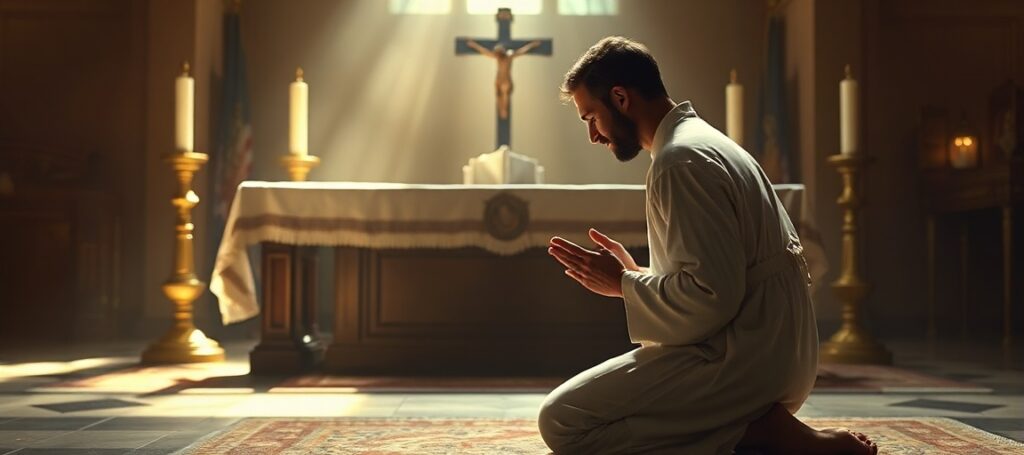
Babe Ruth kneeling in prayer before a Catholic altar holding a Miraculous Medal.
Spiritual

Babe Ruth’s Deathbed Return: A Testament to Catholic Grace Amid a World of Vanity

The National Catholic Register recounts the story of baseball legend George Herman “Babe” Ruth’s lifelong connection to the Catholic faith, his dramatic return to the sacraments before death, and his devotion to the Miraculous Medal. The article, originally from ChurchPop, portrays Ruth’s journey from a wayward life of excess to a final reconciliation with God through confession and Holy Communion before his death in 1948. While the narrative celebrates Ruth’s Catholic identity and his reliance on sacramentals, it glosses over the profound theological gravity of his decades-long estrangement from the Church and the spiritual peril inherent in treating the faith as merely a sentimental comfort rather than the singular path to salvation.

Spiritual

Easter’s Call to Divine Filiation: A Truth Stolen by the Conciliar Sect

National Catholic Register portal (April 10, 2026) presents a commentary by Andrea Picciotti-Bayer on the Easter Octave, focusing on the concept of divine filiation — the truth that through baptism, we become adopted children of God. The article draws on Scripture, the writings of John Paul II, and St. Josemaría Escrivá to explain this foundational Christian reality. While the article correctly identifies divine filiation as a supernatural fact rooted in the Cross and Resurrection, its reliance on a manifest heretic and apostate as a theological authority, coupled with its deafening silence on the state of the Church and the crisis of faith, renders it a hollow echo of a truth that the conciliar sect has systematically undermined.

Spiritual

8,645 Candles at Finland’s Parliament: A Vigil That Exposes the Bankruptcy of the Conciliar Sect’s “Pro-Life” Theater

EWTN News portal reports that on March 21, 2026, the Finnish pro-life group Oikeus elämään ry organized a vigil titled “Muistamme” (“In remembrance”) on the steps of Finland’s Parliament in Helsinki, lighting 8,645 candles—one for each abortion performed in Finland in 2024. The event drew Catholic, Lutheran, and Presbyterian clergy together, including Jean Claude Kabeza, vicar general of the Diocese of Helsinki, conveying greetings from “Bishop” Raimo Goyarrola. Kirsi Morgan-MacKay, chairman of Finland’s Right to Life Association, stated the vigil sought to honor the unborn and confront the public with abortion’s scale, calling it “a spiritual, ethical, and moral issue.” Goyarrola, a physician-turned-priest of the Masonic Opus Dei sect, emphasized “positive language” and “open and respectful conversation” to address abortion’s “complexity.” The event included a prayer gathering at Luther Church with interdenominational clergy. While the vigil’s pro-life intention is commendable in principle, the entire framework—interdenominational ecumenism, the conciliar sect’s compromised “pro-life” advocacy, the absence of any call for repentance or the social reign of Christ the King, and the participation of heretical clergy—reveals the spiritual bankruptcy of the post-conciliar approach to defending the unborn.

Spiritual

The Idolatry of Divine Mercy: A Neo-Church Devotion Rooted in Condemned Mysticism

EWTN News reports on the elaborate celebrations planned for Divine Mercy Sunday at the Kraków-Łagiewniki shrine in Poland, describing a liturgical program of Masses, vigils, confessions, and global broadcasts centered on the revelations of St. Faustina Kowalska. The article presents this devotion as a legitimate and praiseworthy expression of Catholic piety, quoting the supposed words of Christ transmitted through the Polish nun: “I desire that the first Sunday after Easter be the feast of mercy.” It further highlights the shrine’s consecration by John Paul II, who “entrusted the entire world to divine mercy,” and describes the basilica’s symbolic architecture, including a tabernacle shaped like a globe “representing humanity in need of mercy.” The piece concludes with logistical details about multilingual confessions and online broadcasts enabling global participation. This article, however, omits any critical examination of the theological, historical, and doctrinal problems surrounding the Divine Mercy devotion, its seer, and the conciliar apparatus that elevated it to prominence — omissions that reveal the deep entanglement of this cult with the modernist revolution and its project of replacing the Catholic faith with a naturalistic, man-centered spirituality.

Spiritual

Zacchaeus in the Sycamore: A Lost Wonder and the Tree That Still Stands

The National Catholic Register portal, in a commentary by James Day published April 10, 2026, offers a meditation on the Gospel episode of Zacchaeus climbing a sycamore tree to see Christ, drawing from it lessons about childhood wonder, the experience of climbing trees, and the Cross as the ultimate “tree” of salvation. The piece weaves together the Lucan narrative, reflections by Romano Guardini and Joseph Ratzinger, the liturgical hymn Crux fidelis, and G. K. Chesterton on wonder, concluding with an invitation to seek clarity of vision before the Cross. While the article is ostensibly devotional, its theological omissions, its reliance on modernist authorities, and its reduction of supernatural conversion to naturalistic sentimentality betray the very wonder it claims to champion.

Scroll to Top
Antichurch.org
Privacy Overview

This website uses cookies so that we can provide you with the best user experience possible. Cookie information is stored in your browser and performs functions such as recognising you when you return to our website and helping our team to understand which sections of the website you find most interesting and useful.