Antipopes of the Antichurch

News feed

Diocese of Oakland Shuts 13 Churches: A Harvest of Modernist Apostasy, Not a “Solution”

EWTN News reports that the Diocese of Oakland, California, will close 13 parishes due to declining congregations, a severe priest shortage, and mounting financial pressures. Bishop Michael Barber described the move as a “necessary step” to focus on “prayerful celebrations of the Mass” and “missionary disciples.” This announcement, framed as a pragmatic response to “operational realities,” is yet another stark symptom of the Church’s profound spiritual and institutional bankruptcy since the conciliar revolution, where the abandonment of immutable Catholic doctrine has inevitably led to the abandonment of its physical infrastructure.

Nuclear Disarmament Plea Exposes the Conciliar Sect’s Abdication of Christ the King’s Social Reign

EWTN News reports that five Catholic bishops from the United States and Japan — representing the so-called “Partnership for a World Without Nuclear Weapons” — issued a statement on April 27, 2026, warning that the Nuclear Non-Proliferation Treaty (NPT) is “badly frayed, perhaps even in danger of collapsing,” and urging world leaders to renew commitments to nuclear disarmament. The bishops, whose dioceses include Seattle, Santa Fe, Nagasaki, and Hiroshima, lamented that “nuclear threats are escalating” and that “massive modernization programs” aim to “keep nuclear weapons forever.” They called the possession of such weapons “immoral” and “genocidal,” and expressed skepticism that the ongoing NPT review conference would yield genuine progress. This statement, while cloaked in the language of peace and life, is a textbook example of the post-conciliar Church’s reduction of Catholic social teaching to secular humanitarianism, its silence on the supernatural order, and its implicit denial of the Church’s divine mandate to teach, govern, and judge the nations in the name of Christ the King.

A Pilgrimage in the Shadow of the Conciliar Abomination: The NSC Italy March and the Illusion of Reform from Within

EWTN News reports on the “Our Lady of Christendom” pilgrimage (NSC) in Italy, an event organized by young Catholics devoted to the Traditional Latin Mass. The three-day trek from St. Mary Major in Rome to Subiaco, involving 160 participants from various nations, was presented as a quest for the “sanctification of souls” and the restoration of the “spirit of Christendom.” While the physical act of pilgrimage and the desire for spiritual growth are commendable in themselves, this event, by its very nature and the context in which it occurs, serves as a poignant illustration of the profound theological confusion and spiritual peril that defines the post-conciliar landscape. It is a manifestation of a well-intentioned but ultimately futile attempt to restore Christendom while remaining in communion with the very structures that have dismantled it.

The Allure of “Christendom” in an Age of Apostasy

The stated aim of the NSC pilgrimage is to “contribute to the restoration of the spirit of Christendom.” This aspiration, while noble in its intent, is rendered tragically hollow by the very context in which it is pursued. The “spirit of Christendom” was not merely a cultural phenomenon but a social order built upon the recognition of the Kingship of Christ over all nations and individuals, a truth solemnly defined by Pope Pius XI in his encyclical *Quas Primas*: “The Kingdom of our Redeemer encompasses all men… the entire human race is subject to the authority of Jesus Christ.” This reign demands that states, not just individuals, publicly honor and obey Christ, ordering their laws and governance according to His commandments.

However, the very “Church” with which these pilgrims seek communion has, since the Second Vatican Council, systematically dismantled the foundations of Christendom. The conciliar declaration *Dignitatis Humanae* enshrined the very religious indifferentism and laicism that Pius XI condemned as a “plague” and a “public apostasy.” The “Church” of the New Advent has embraced dialogue with the world on the world’s terms, abandoning its prophetic mission to condemn error and call nations to conversion. To speak of restoring “Christendom” while recognizing the authority of the very “popes” and “bishops” who have legitimized the secularization of society is a contradiction in terms. It is like trying to rebuild a house while the foundation is being actively demolished by the very architects one acknowledges as legitimate. The “Christendom” they seek cannot be restored by offering prayers and sacrifices within a structure that has formally repudiated the social reign of Christ.

The Traditional Latin Mass: A Lifeline or a Leash?

The article highlights that these young people “attend the Traditional Latin Mass and do not belong to any religious organization or community.” This distinction is crucial, as it underscores the central role of the *Usus Antiquior* in preserving the faith. The Traditional Latin Mass, with its emphasis on the propitiatory sacrifice, the transcendence of God, and the reality of sin and judgment, is indeed a beacon of truth in a world shrouded in spiritual darkness. It is the Mass that built Christendom, the Mass that for centuries nourished the saints and martyrs.

Yet, the mere attendance at this Mass, while a necessary condition for salvation, is not sufficient to guarantee the restoration of Christendom or even the sanctification of souls if it is divorced from a clear understanding of the current ecclesiastical crisis. The article notes that the pilgrimage concluded at Subiaco, where “St. Benedict… laid the foundations of Western monasticism.” St. Benedict’s rule was not merely a guide for monastic life but a blueprint for a Christian society, one ordered to God and His laws. The modernist “Church,” however, has embraced a “monasticism” of dialogue and adaptation, where the pursuit of holiness is often reduced to social activism and emotional experiences.

The danger lies in the illusion that the Traditional Latin Mass can be a vehicle for the restoration of Christendom while remaining under the jurisdiction of the conciliar “bishops” and “popes” who, at best, tolerate it as a pastoral concession and, at worst, seek to suppress it. This is the error of those pretending to be traditional Catholics, who, while preserving the outward forms of worship, fail to grasp the full implications of the modernist revolution. As the *Defense of Sedevacantism* document argues, a manifest heretic, by that very fact, ceases to be Pope and head. If the occupant of the Apostolic See is a manifest heretic, then his jurisdiction is null and void, and any “permission” or “tolerance” he extends to the Traditional Mass is spiritually meaningless and potentially a trap to keep the faithful within the orbit of a dying system.

The Symptom of Spiritual Confusion: “Communion” with Usurpers

The article quotes Giacomo Mollo, one of the organizers, who speaks of “the communion of faith experienced while participating in the holy Mass according to the ‘Usus Antiquior’.” This phrase, while expressing a genuine sentiment of unity among the participants, inadvertently reveals the profound spiritual confusion that plagues even the most devout Catholics in the post-conciliar era. True “communion of faith” can only exist within the true Church, the one founded by Christ, which is indefectible and cannot err. The conciliar sect, by its official teachings on religious freedom, ecumenism, and the evolution of dogmas, has placed itself outside the bounds of this true communion.

To speak of “communion” with those who uphold the very errors that have led to the current crisis is to misunderstand the nature of the Church itself. The Church is not a democratic association of like-minded individuals but a hierarchical society instituted by Christ, where unity of faith is paramount. The “bishops” and “priests” who officiate at these pilgrimages, even if they offer the Traditional Mass, are often recognized by the conciar structures, thereby lending legitimacy to the very system that has betrayed Christendom. This is akin to a group of loyal soldiers fighting for a king while acknowledging the authority of the usurper who has seized the throne.

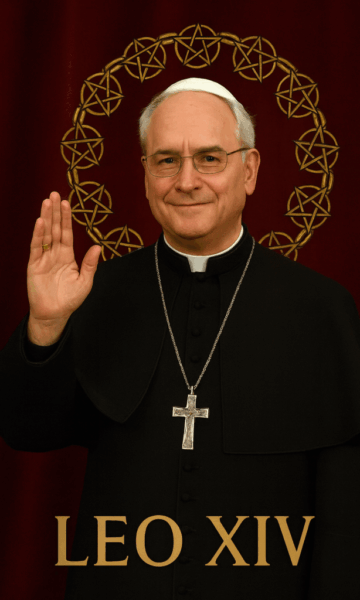
Furthermore, the article mentions that the pilgrims visited the shrine of Our Lady of Good Counsel in Genazzano, “to whom Pope Leo XIV has a special devotion.” This detail is particularly poignant. The devotion to Our Lady of Good Counsel is a beautiful and ancient tradition, but its association with the current antipope, Robert Prevost, is deeply problematic. The “Church” of the New Advent has a long history of co-opting authentic Catholic devotions and figures to lend credibility to its modernist agenda. The mention of Leo XIV’s “special devotion” serves to subtly reinforce his legitimacy in the eyes of the faithful, further entangling them in the web of the conciliar abomination. It is a reminder that even the most sincere acts of piety can be instrumentalized by those who seek to maintain the status quo.

The Path Forward: Not Reform, but Rejection

The organizers of the NSC pilgrimage are described as “working on next year’s pilgrimage, as they expect a larger number of pilgrims.” This enthusiasm and growth are commendable, but they must be tempered by a clear understanding of the current reality. The path to the true sanctification of souls and the restoration of Christendom does not lie in seeking reform from within the conciliar structures, but in a complete and uncompromising rejection of the modernist revolution.

The *False Fatima Apparitions* document warns against “the centralized role of the Church and the sacraments” being undermined by “hyper-acts” of worship, and the “efficacy of Holy Mass” being diminished in favor of “spectacular acts.” While a pilgrimage is not inherently a “hyper-act,” the emphasis on the experience itself, rather than the doctrinal clarity regarding the current crisis, can lead to a form of spiritual escapism. The true “pilgrimage” of the Catholic in these times is not merely a physical journey but a spiritual one, a journey out of the Babylon of conciliarism and into the clarity of unchanging Tradition.

This requires a firm adherence to the principles outlined in the *Syllabus of Errors* and *Lamentabili sane exitu*, which condemn the very errors that have led to the current crisis. It requires a recognition that the “Church” of the New Advent is not the true Church, but a counterfeit, and that true sacraments and true authority can only be found outside its orbit. The faithful must not be deceived by the outward beauty of the Traditional Latin Mass if it is offered within the context of a system that has formally repudiated the social reign of Christ and embraced the principles of the French Revolution.

In conclusion, while the desire for sanctification and the restoration of Christendom is laudable, the NSC Italy pilgrimage, as described, exemplifies the tragic dilemma of many well-intentioned Catholics. They seek to build on a foundation that has been destroyed. True restoration will only come when the faithful, guided by the unchanging teaching of the Church Fathers and the pre-conciliar Magisterium, have the courage to reject the conciar abomination entirely and seek the true Church, even if it means standing alone in the wilderness of modern apostasy. As St. Pius X warned in *Pascendi Dominici Gregis*, “the pursuit of novelty… leads to the most grievous errors.” The only true novelty is the eternal truth of Christ, which the modernist “Church” has abandoned.

Embezzlement of $1.4 Million by Tulsa Deacon Exposes Moral Bankruptcy of the Conciliar Sect

Federal prosecutors allege that Deacon John Sommer, serving as both business and parish manager at Christ the King Parish in Tulsa, Oklahoma, stole approximately $1.4 million in parish funds between March and October 2025. According to charging documents filed in U.S. District Court, Sommer—authorized to initiate daily transactions up to $30,000—executed dozens of unauthorized transfers into a private bank account while falsifying accounting records to conceal his actions. The Diocese of Tulsa has placed him on a “leave of absence,” and the parish claims most funds were recovered via insurance. This scandal is not an isolated failure of individual morality but a symptomatic fruit of the post-conciliar Church’s systemic abandonment of supernatural discipline, doctrinal clarity, and true ecclesial authority—conditions that enable such rampant financial and spiritual corruption.

Varia

Announcement:
News feedimplemented

Antipopes separate web sites with their all documents refutation – in progress

Categories

Categories

Archive

Czytnik artykułów

Zatrzymano

Playlista

Tekst

Scroll to Top
Antichurch.org
Privacy Overview

This website uses cookies so that we can provide you with the best user experience possible. Cookie information is stored in your browser and performs functions such as recognising you when you return to our website and helping our team to understand which sections of the website you find most interesting and useful.